
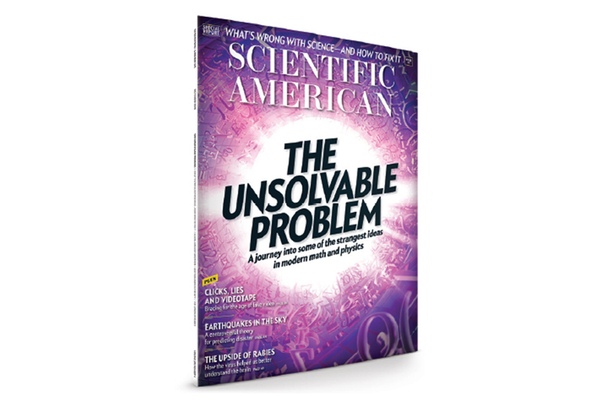
“This idea might seem obvious, but mathematics is about establishing concepts with absolute certainty,” write Toby S. Cubitt, David Pérez-García and Michael Wolf in this issue's cover story, “The Unsolvable Problem.” In their feature, they describe a mathematical odyssey to demonstrate the “undecidability”—that is, the unsolvable nature—of a certain problem in quantum physics. The journey takes them on a three-year “grand adventure,” from a small town deep in the Austrian Alps into a world of complicated mathematics. The result was a 146-page proof and publication in the journal Nature.
Several years ago a few different trips of my own—to Moscow, Doha (Qatar), Beijing and others—inspired the series “State of the World's Science.” At the time, I was struck by how other countries looked to science and invested in it, with a variety of national goals. I decided that Scientific American, with 14 translated editions, should make a point of taking an annual look at this global enterprise.
In this year's special report, headed by senior editor Clara Moskowitz, we are looking at the challenges of research today. In “Make Research Reproducible,” Shannon Palus examines the problem of reproducibility: a large percentage of scientific papers cannot be replicated by other researchers. The reasons can include multiple factors, such as imprecise methods, bad reagents and flaws in data collection. John P. A. Ioannidis writes about the ways we can “Rethink Funding,” from not spending enough to properly financing the work in the first place to problems with the reward systems for individuals. He also outlines potential solutions. In “Help Young Scientists,” Rebecca Boyle discusses the difficulties faced by individuals at the start of their career. Rounding out the section, in “Break Down Silos,” Graham A. J. Worthy and Cherie L. Yestrebsky focus on interdisciplinary teamwork.
On supporting science journalism
If you're enjoying this article, consider supporting our award-winning journalism by subscribing. By purchasing a subscription you are helping to ensure the future of impactful stories about the discoveries and ideas shaping our world today.
Elsewhere in the issue, you can discover how engineered forms of the rabies virus have provided new insights into the brain's inner workings; ponder a controversial theory that holds that the best early warnings of an earthquake could appear 180 miles above the ground; learn about new ways to evacuate in the event of a hurricane; and consider the all too disturbing reality of fake videos. As always, we hope that you enjoy making your way through the feature articles in this edition. We welcome your comments.