
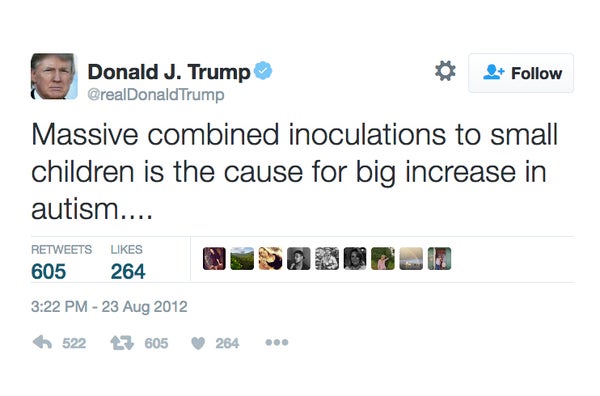
A White House panel that questions vaccine safety and attacks immunization standards set by the U.S. Centers for Disease Control—a possibility raised last week in meetings with incoming president Donald Trump—could actually lead to increased disease outbreaks. Environmental lawyer Robert F. Kennedy, Jr., who suggests inoculations are linked to autism, met last week with Trump to discuss a panel to examine what Kennedy called “vaccine safety and scientific integrity.” Although the autism–vaccine claim has been studied and debunked, the president-elect has also suggested a connection. His team later hedged about the panel, saying that nothing had been decided. (Kennedy’s office declined an interview request.) Nevertheless, public health experts and autism advocates are deeply worried that an effort with presidential backing could undermine public confidence in vaccines and trigger epidemics of all-but-eradicated diseases.
“We have dozens of studies examining autism and vaccines, and they don’t show a link,” says Alison Singer, president of the Autism Science Foundation, a nonprofit that supports autism research. The original 1998 Lancet article purporting to tie vaccines to autism was found to be based on fraudulent data and retracted; its lead author, Andrew Wakefield, has been barred from practicing medicine in the U.K. “My fear is that people will think that we have not done these studies. That fear alone could lead people to withhold vaccines from their children,” Singer says.
A presidential panel could amplify fears. Such bodies are often appointed not only to develop policies or investigate problems but to mold public opinion, says Jordan Tama, an assistant professor with American University’s School of International Service, who has studied the history of presidential panels. They typically hold public hearings and issue official findings that command respect and get media attention. But this one’s different. “I can’t think of a past example of a president creating a commission on an issue where the agenda seemed to be so far out of the mainstream,” Tama says.
On supporting science journalism
If you're enjoying this article, consider supporting our award-winning journalism by subscribing. By purchasing a subscription you are helping to ensure the future of impactful stories about the discoveries and ideas shaping our world today.
A vaccine–autism panel could put the authority of the White House behind false assertions, Tama adds. And there is evidence such an effort would find a receptive, already growing audience in some communities. A 2011 study
by CDC scientists showed that whereas the overwhelming majority of parents reported vaccinating their children, 30 percent worried that such inoculations might cause learning disabilities including autism. Surveys of pediatricians, analyzed in Pediatrics, found the proportion of doctors reporting that parents had refused vaccines for their children increased from 74.5 percent in 2006 to 87 percent in 2013.
The refusals have health consequences. In 2014–15 a measles outbreak began at Disneyland in Anaheim, Calif., spread to other towns and cities, and 125 people fell ill. A later epidemiological study estimated the vaccination rate in communities where the disease spread was no higher than 86 percent and might be as low as 50 percent. Epidemiologists say it takes a much higher rate—96 to 99 percent—to provide the “herd immunity” that effectively inhibits outbreaks. Orange County, where Disneyland is located, has a number of communities with low vaccination rates; in California measles vaccination rates have been falling for more than a decade. “We are seeing upticks in small clusters of childhood illnesses,” says the lead author of the Disneyland study, Maimuna Majumder, an epidemiologist and doctoral student at the Massachusetts Institute of Technology. Recent outbreaks of mumps, for example, have sickened more than 4,000 people, more than half of those in Arkansas. “This is preventable, and it’s thousands and thousands of people,” Majumder says. “And it’s because there’s a shift in the way people are treating vaccines.”
Parents who vaccinate their children but worry about safety “could be a tipping point,” says Jason Schwartz, an assistant professor of public health policy at Yale University who specializes in vaccines and vaccine programs. “If even a subset of that group of parents who are somewhat on the fence start doubting, that would very quickly lead to a crisis.” Viruses only need to find a few pockets of unprotected children to begin spreading widely and wildly through a bigger population.