
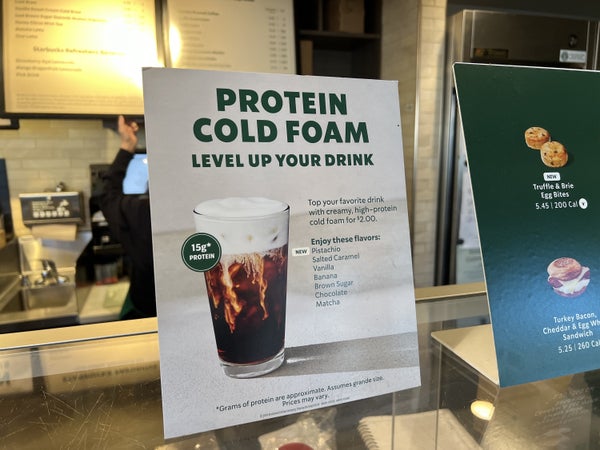
Coming home from a harder-than-usual workout, I felt I deserved a reward. When I saw that my local Starbucks menu advertised a vaguely healthy-sounding iced caramel protein matcha latte with the option to add protein-boosted cold foam, I decided to give it a try. The drink boasted 46 grams of protein—more than seven times the amount of protein in an egg.
It tasted like drinking a cup of melted caramel ice cream. I gave up after a few sips.
Protein-boosted foods and drinks are everywhere these days, from lattes to Pop-Tarts to potato chips. The protein-packing trend has even reached the government’s new upside-down food pyramid: The new dietary guidelines website declares that the U.S. is out to win the “war on protein.”
On supporting science journalism
If you're enjoying this article, consider supporting our award-winning journalism by subscribing. By purchasing a subscription you are helping to ensure the future of impactful stories about the discoveries and ideas shaping our world today.
Yet evidence suggests many Americans already get more than the recommended daily amount of protein. And although some people might benefit from a higher protein intake, simply consuming protein-packed Pop-Tarts, scientists say, isn’t the way to do it. (Starbucks declined to comment for this article; Kellanova, the maker of Pop-Tarts, did not respond to a request for comment.)
The body needs protein, but how much?
Protein is essential for our bodies. The amino acids in the proteins we eat get broken down and used as building blocks for the proteins in our own cells that perform vital functions such as generating energy, copying DNA and turning DNA instructions into other proteins. Our cells rely on 20 amino acids, most of which our bodies can build themselves if needed. But nine of these, called essential amino acids, must come from our diet.
“You can have very high or very low amounts of fat and carbohydrates and survive,” says Anja Bosy-Westphal, a nutrition researcher at Kiel University in Germany, “but you need a certain amount of protein.”
Diet studies in the U.S. in the 1980s found that the average person needed 0.66 grams of protein per kilogram of body mass to maintain their muscle mass. Until recently, the recommended daily allowance, or RDA, for protein has been 0.8 grams per kilogram (g/kg)—a healthy amount above the estimated average to ensure people get enough. The new dietary guidelines which Robert F. Kennedy, Jr., Secretary of Health and Human Services, announced this year, pump it up to 1.2 to 1.6 g/kg.
Most people in the U.S. are getting more than 0.8 g/kg, says Claire Berryman, a nutritional scientist at the Pennington Biomedical Research Center at Louisiana State University. In a 2018 study, she and her colleagues analyzed protein intake from the National Health and Nutrition Examination Survey—a study of thousands of Americans’ eating patterns—from 2001 to 2014. “Most people were at one gram per kilogram body weight or higher,” she says.
Why some people might need more protein
Even if the majority of people get enough protein, most people isn’t everyone, says Joseph Matthews, who studies protein metabolism and protein nutrition at the University of Arkansas for Medical Sciences. “The case study I like to use here is my mum—who is 67—who doesn’t eat a lot of calories across a day,” Matthews says. “It becomes quite hard for her to get sufficient protein within that calorie budget.”
In addition, many older adults are at risk of muscle wasting—especially if they become ill or injured. Some short-term trials have suggested that high-protein diets can prevent muscle loss in older people, Berryman says. If older people consume more protein, they may be able to stop the loss and maintain muscle mass, she says.
Another group at risk of muscle loss is people who lose large amounts of weight in a very short amount of time—say, as a result of taking glucagonlike peptide 1 (GLP-1) drugs such as Wegovy. These individuals are taking in fewer calories than the average person. “I would suggest that those people should have a higher protein intake” in this phase of massive weight loss, Bosy-Westphal says. And associations of nutrition researchers already recommend that severely ill people and athletes consume higher levels of protein, she says.
To cater to those who need more protein and those who need less, Matthews suggests changing the recommended daily value of protein to a range—one that accounts for people’s activity levels, ages and needs. The historically recommended amount of 0.8 g/kg, he argues, “can be seen as the floor, not the ceiling.” It’s enough to keep the muscle you have but not build more, he says. A range of about 1.2 to 1.5 g/kg has been recommended by nutritionists for athletes. “The top of that range is going to be for leaner people who are engaged in structured strength training [and] resistance training,” he says.
Popular protein
Yet most of us—even those hitting the gym a few times a week—aren’t elite athletes and don’t need the extra help. “If you have your average young, particularly male, American who doesn’t have a restrictive diet,” Matthews says, “they’re probably active.... They are very unlikely to have a protein problem.”
So why do we see extra protein as extra-good? “I think that fat and carbohydrates have each been villainized in their own ways over time,” Berryman says. “Proteins feel safer, maybe.”
The fact that higher protein intake could increase muscle growth has been taken out of context, she says. “It’s been blown up to this big craze that everyone’s going to be able to build muscle just because they’re eating protein.” But merely eating protein isn’t going to build muscle. “You have to combine it with exercise,” she says.
Protein has also been touted for weight maintenance, Bosy-Westphal notes. Protein can help people feel fuller for longer. But all the other food groups someone is eating must be taken into account. “People think just buying the protein-supplemented food keeps you from putting on weight,” she says. “It’s not the case.”
In a 2025 study, Bosy-Westphal showed that protein-enhanced ultra-processed foods didn’t prevent overeating, although they did appear to help people consume fewer calories. But the study included high-protein foods that were also low-carb. Many protein-packed processed foods and drinks are packed with sugar and fat. The protein label, Bosy-Westphal says, “is a health halo.” It makes a food look better for you and takes away some of the guilt, but it doesn’t make the food healthy. “A high-protein drink is doing the same as [any] other liquid drink,” she says. For example, the high-protein latte I tried also contained at least 24 grams of sugar—about half of the past U.S. dietary guidelines’ recommended limit for daily intake. (The new guidelines state that no amount of added sugars is recommended and that no one meal should have more than 10 grams of added sugars.)
Protein-packed processed foods aren’t necessarily bad for everyone. “If you’ve got an athlete who’s taking in 3,000 calories or more, and they want to have a few Pop-Tarts, I’ve zero problem with that,” Matthews says.
But for people who consume fewer calories, like Matthews’s mother, those calories and the protein in them are better off coming from whole foods—such as chicken, beans, nuts and vegetables. “Protein is one part of a whole diet,” Matthews says. “We shouldn’t be thinking about it or writing about it as if it is the only thing in a diet that matters.”