
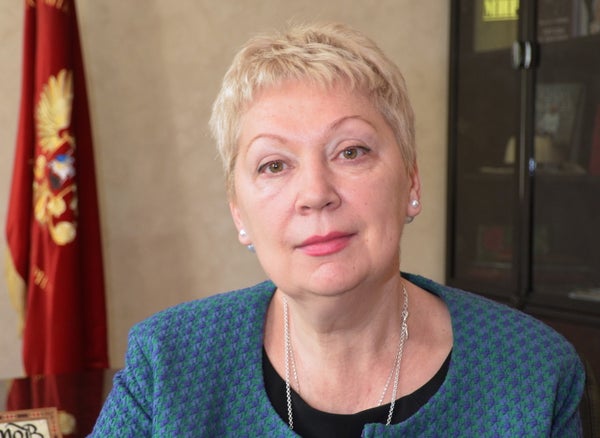
Russian President Vladimir Putin has appointed a church historian as the country’s new science and education minister.
On August 19, the president announced that Olga Vasilyeva would succeed the current science minister, Dmitry Livanov, who will become presidential envoy on trade and economic relations with Ukraine, according to the Russian news agency Interfax.
During his 4-year term as minister, Livanov oversaw a radical overhaul of the Russian Academy of Sciences, Russia’s main basic research organization. The formerly separate academies of sciences, medical sciences and agricultural science were merged and put under the governance of a federal agency. Livanov told Nature last year that the academy’s future role will mainly be to provide expert advice to the government and society.
On supporting science journalism
If you're enjoying this article, consider supporting our award-winning journalism by subscribing. By purchasing a subscription you are helping to ensure the future of impactful stories about the discoveries and ideas shaping our world today.
But many members of the academy, which runs hundreds of research institutes across Russia, are unhappy with the changes and with the way that Livanov handled the painful reform. Vladimir Ivanov, a vice-president of the academy, told the Rossiyskaya Gazeta news portal that he welcomed the move because Livanov had failed to involve scientists and academic officials in the overhaul of the academy.
Unexpected proposal
In making the decision, Putin followed a proposal made by prime minister Dmitry Medvedev, according to Interfax.
Putin gave no reason for Livanov’s replacement. The minister was unpopular in public for his education policies—many parents are upset, for example, that they must now pay fees for their children's school textbooks, according to Rossiyskaya Gazeta. But whether a lack of public popularity was the reason for Livanov’s dismissal is unclear. Putin and Medvedev did value Livanov’s work, and they say that they consider his experience to be important in other spheres, according to the Russian news agency TASS.
Some scientists fear that Vasilyeva’s appointment might mark a rise of Christian orthodoxy and religious attitudes in the realms of school education, higher learning and public life. But Vasilyeva, formerly in charge of religious public education in the presidential administration, told Interfax that religion will not interfere with her future work as education and science minister.
This article is reproduced with permission and was first published on August 22, 2016.