
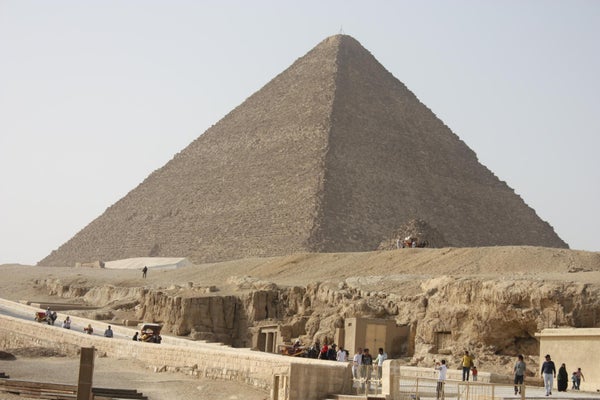
Perhaps it's natural, given the scale of these massive Egyptian icons of stone, that archaeologists have long focused on the construction methods and engineering used to create the Giza pyramids. Now we are at last learning that behind the heavenward movement of the looming tombs, there is an equally remarkable rise: that of an intricate and far-flung social network.
New discoveries are revealing the real secrets of success for the pharaohs: government, labor and trade infrastructures that not only got the pyramids built but also set the stage for centuries of Egyptian prosperity and shaped the growth of civilization. The trade networks drew wealth to Egypt and powered the economies of its trading partners abroad. Turn to page 32 for our cover story, “The Pyramid Effect,” by Zach Zorich.
Modern trade—in olives and their precious oil—is thought to be under threat from a bacterial scourge, Xylella, being ferried by insects across groves in southern Italy. Whereas some have called for the seeming reliability of mass cuttings as a solution to prevent further spread, scientists remain uncertain about exactly how—or even whether—the bacterium is actually at fault for damaging the trees of Puglia. “Hard data are scarce,” writes Barbie Latza Nadeau in “The Battle of Olives,” starting on page 52, “so the scientists and local authorities tend to stay silent, which many growers interpret as a cover-up for ulterior motives.”
On supporting science journalism
If you're enjoying this article, consider supporting our award-winning journalism by subscribing. By purchasing a subscription you are helping to ensure the future of impactful stories about the discoveries and ideas shaping our world today.
As scientists, farmers and officials struggle to bridge a gap in perception and shared understanding about a shared problem in the absence of sufficient data, I reflect on the paradox presented by “Baby Talk,” by Patricia K. Kuhl, beginning on page 64: that kind of communication is child's play ... for youngsters. We are born with a fleeting ability to understand and master any of the world's 7,000 languages. Infants of just a few months of age can pick up the unique acoustic properties of languages from around the globe and speak in full sentences just a couple of years later. After the age of seven, fluency in a second language becomes more elusive. As always, I find myself marveling at the power of children to give us adults a lesson; see the accompanying box for more on that.
Google Science Fair Winners
Now in its fifth year, the Google Science Fair draws entries by students ages 13 to 18 from around the globe. Scientific American's $25,000 Innovator Award, for projects in biology, chemistry, physics or the behavioral sciences, went to Krtin Nithiyanandam. We also recognized Lalita Prasida Sripada Srisai with a $10,000 Community Impact Award. Both honors come with a year of mentoring and access to our 170 years of digital archives for the winners' schools (ScientificAmerican.com/education).