
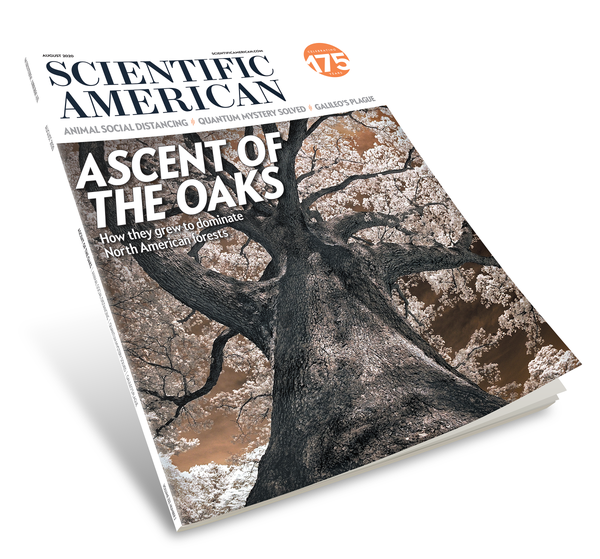
During this strange and scary pandemic year, a lot of people have been spending more time outdoors, admiring flowers and listening to birds they may have rushed past in the Before Times. The more you learn about nature, the more fascinating it is, and this month's cover story on oaks may help you appreciate these majestic trees. Plant scientists Andrew L. Hipp, Paul S. Manos and Jeannine Cavender-Bares show that over the past 56 million years, oaks have evolved into 435 species with elaborate adaptations that let them thrive in habitats around the world, dominating many North American forests.
Our other natural world feature story this month reveals that we can learn pandemic survival skills from other species. House finches, spiny lobsters, guppies, ants, mandrills, and more can recognize illness and practice social isolation to avoid infecting others in the group. Dana M. Hawley and Julia C. Buck, experts on animals and disease, describe these newly relevant behaviors.
We can learn from history as well. A plague outbreak in the 1630s gave Galileo an excuse to publish his Dialogue concerning the Two Chief World Systems (the one about how Earth moves around the sun) in nearby Florence rather than Rome, evading the Vatican's censors, at least for a while. He had to quarantine when summoned for a trial for heresy, and his daughter sent provisions to care for him remotely. Historian Hannah Marcus begins the story here.
Humans became human through friendliness, researchers Brian Hare and Vanessa Woods assert, likening the process to the domestication of wolves into dogs. The ability to create large and versatile social networks may have been our greatest evolutionary advantage.
Having a strong and healthy community is a key indicator of quality of life, according to Joseph E. Stiglitz. He and other economists increasingly say that gross domestic product is a mismeasure of a country's economic well-being, and a focus on GDP has impaired our ability to prepare for pandemics. Education, environmental quality, housing, safety and health are what really matter.
Limiting climate change will require many solutions, and agroforestry experts Eric Toensmeier and Dennis Garrity explain how growing trees among crops and pastures can use land more efficiently to grow biomass that removes carbon dioxide from the atmosphere.
One of the great mysteries in physics has been the quantum Hall effect, which is the surprising behavior of electric currents under certain conditions to change in a stepwise fashion rather than smoothly. Mathematician Spyridon Michalakis tells us how he helped to solve the problem using a field of mathematics called topology, which studies the fundamental properties of shapes.
Thank you for reading Scientific American, and I hope you all are having a safe and healthy summer with plenty of opportunities to enjoy the shade of an oak tree.