
In the first fraction of a second after the big bang, the universe was a hot, dense ocean of perfectly free-flowing particles called a quark-gluon plasma. It didn't last long—all the gluons and various flavors of quarks and antiquarks were almost immediately sucked into protons and neutrons and held in place by the powerful fundamental force called the strong force. And that's where they all remained for 13.7 billion years, until scientists figured out how to re-create a quark-gluon plasma in a particle accelerator. By studying this fleeting primordial ooze, they hope to better understand the beginnings of the universe, as well as what's really happening inside a proton, which, as Scientific American senior space and physics editor Clara Moskowitz explains, is basically chaos.
Do you ever have the sense that you can perceive numbers? One of the oldest debates in philosophy is whether people have an innate ability to process numbers or must be taught. Philosophers Jacob Beck and Sam Clarke say they can finally answer the question. According to recent research in infants, young children, adults and animals, it's clear to the authors that humans do have some natural perception of quantities that is inborn and unconscious. It's fun to explore how we think about numbers and how our numeracy may have evolved.
The world population recently surpassed eight billion people, up from seven billion in 2011, six billion in 1999 and five billion in 1987, and doubling the planet's 1975 population of four billion. Such growth presents challenges for us and other species on Earth, as historian of science and Scientific American columnist Naomi Oreskes observes. Graphic journalist and Scientific American contributor Katie Peek shows how birth rates are beginning to decline, especially in poorer countries. The best way to make the world population healthy and sustainable, experts agree, is to educate and empower girls and women.
On supporting science journalism
If you're enjoying this article, consider supporting our award-winning journalism by subscribing. By purchasing a subscription you are helping to ensure the future of impactful stories about the discoveries and ideas shaping our world today.
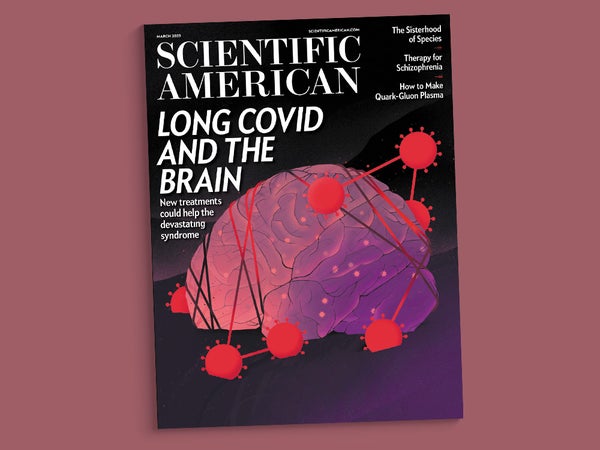
Researchers are coming to a consensus that long COVID is in many cases a neurological disease. The virus that causes COVID, SARS-CoV-2, can persist in the nervous system for months, and it may bring on ministrokes, inflammation, or immune system disruptions that affect the nervous system. Neuroscientist and science journalist Stephani Sutherland discusses the various ways COVID can produce lasting symptoms and how understanding these mechanisms suggests more ways to treat the syndrome.
Our universe may be a hologram. As author Anil Ananthaswamy describes, physicists made a conceptual breakthrough 25 years ago: the four-dimensional world we inhabit could emerge out of a reality that has a different number of dimensions, just as a hologram, which looks three-dimensional, emerges from two dimensions arrayed just right.
New approaches to treating schizophrenia are helping people manage some of the social and emotional aspects of the disorder. Matthew M. Kurtz, a professor of psychology and neuroscience, writes that people with schizophrenia can learn to improve personal problem-solving and control distressing beliefs—things today's antipsychotic medications aren't always useful for.
Barbara Natterson-Horowitz, a cardiologist and evolutionary biologist, started understanding her human patients better once she began treating zoo animals. Giraffes, zebras, cheetahs and hyenas have gestational adaptations that could help pregnant people, and studying heart disease and breast cancer across species could identify novel treatments. She refers to the similarities among female animals as “the sisterhood of species.” Isn't it nice when you learn something that makes you look at the world in a different way?