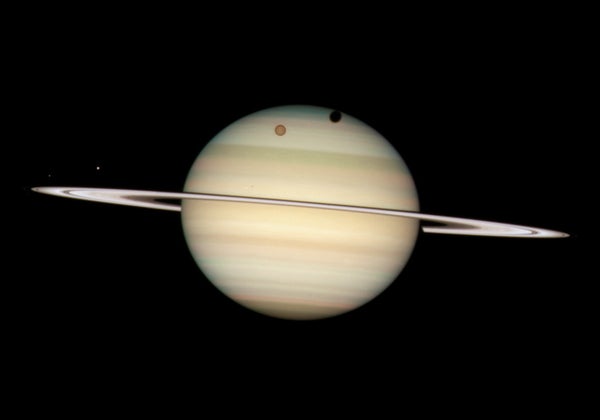
The Hubble Space Telescope captured four of Saturn's moons transiting , or passing in front of their planet, at once.
NASA, ESA, and the Hubble Heritage Team (STScI/AURA)
Join Our Community of Science Lovers!
On supporting science journalism
If you're enjoying this article, consider supporting our award-winning journalism by subscribing. By purchasing a subscription you are helping to ensure the future of impactful stories about the discoveries and ideas shaping our world today.
The Hubble Space Telescope captured four of Saturn's moons transiting, or passing in front of their planet, at once. In this February image from Hubble's Wide Field Planetary Camera 2, Saturn's largest moon, Titan, and its shadow are plainly visible across the ringed planet's northern hemisphere. The much smaller Mimas is barely visible as a whitish dot below and to the left of Titan (just above the rings), but can be found next to the more apparent dark shadow it casts across the gas giant. To the left of the image is Dione, which appears to hover above the rings, and Enceladus, the tiny speck at the rings' edge. Hubble's view was made possible by the fact that the plane of Saturn's rings aligns with our line of sight in 2009—the rings will be perfectly "edge-on" on September 4. (At that time, however, Saturn's position relative to the sun will largely preclude observation from Earth.) This alignment takes place every 15 years or so as Saturn makes its 29.5-year orbit around the sun and has not occurred since 1995–1996.
It’s Time to Stand Up for Science
If you enjoyed this article, I’d like to ask for your support. Scientific American has served as an advocate for science and industry for 180 years, and right now may be the most critical moment in that two-century history.
SciAm always educates and delights me, and inspires a sense of awe for our vast, beautiful universe. I hope it does that for you, too.
If you subscribe to Scientific American, you help ensure that our coverage is centered on meaningful research and discovery; that we have the resources to report on the decisions that threaten labs across the U.S.; and that we support both budding and working scientists at a time when the value of science itself too often goes unrecognized.