
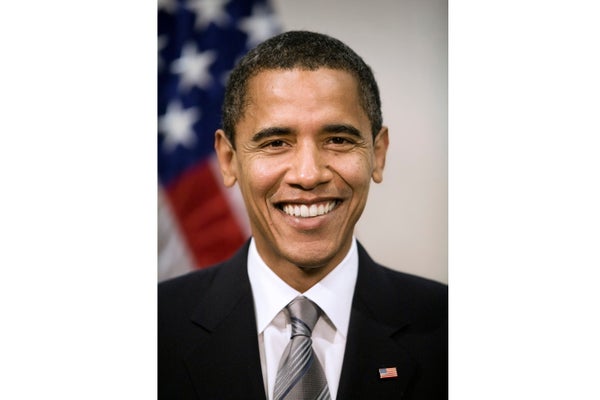

The color of a candidate’s skin failed to sway voters to depress the lever for either Obama or McCain in the 2008 election, immediate analyses of that contest seemed to suggest. Some pundits hailed it as the first postracial election.
But a closer look after the election has revealed a much more nuanced picture of that historic faceoff. It turns out that as many as a fifth of the voters cared about race more than other considerations like gender, endorsements by a local newspaper or a candidate’s political party.
A study by political scientist Brian F. Schaffner at the University of Massachusetts, Amherst in the December issue of Political Psychology showed that concerns about race may have meant that Obama procured 3 percent less of the vote than he would have if he were white—enough to decide an election in a close race. “It’s pretty clear that if Obama were white he would have done better than he did,” Schaffner says.
On supporting science journalism
If you're enjoying this article, consider supporting our award-winning journalism by subscribing. By purchasing a subscription you are helping to ensure the future of impactful stories about the discoveries and ideas shaping our world today.
His finding echoes the results of similar probings by other researchers into the 2008 statistics. Schaffner’s work stands out, though, because of the care that he took in trying to figure out whether a voter was trying to mask biases about the hyper-sensitive issue of race. The researcher devised what he calls an “unobtrusive observational measure” to try to elicit a voter’s real opinions.
Schaffner deployed a simple ranking method to get beyond what political scientists call “social desirability bias:” voters’ attempts to cover up opinions that they know might be repellent to others. After the election, Schaffner asked 934 respondents, 825 of whom voted, to rank the importance of six items from most to least helpful in making a decision.
Whites who placed race higher on the list, which included a candidate’s gender, occupation, political party and other factors, were less likely to vote for Obama, The definition of “higher” encompassed any ranking from first to fourth on the list, allowing the survey to detect the importance of race even if respondents didn’t rank that category first and may have wanted to hide their views.
These findings held up even after taking into account a measure of political conservatism, specifically, opposition to affirmative action. A white respondent who opposed affirmative action but put race last instead of fourth on the list was 25 percent more likely to vote for Obama. In the 2012 election, Schaffner wants to use the same method to examine, not only race, but this year’s added hot-button issue of Mitt Romney’s religion.
A well-known political blog, The Monkey Cage, raised the question of whether trying to deduce voters’ recondite opinions was really needed. John Sides, a political scientist at George Washington University, noted that other studies had produced similar results even when asking respondents more directly about their racial prejudices. Schaffner defends his methodology, citing evidence from exit polls that indicates that social desirability bias really matters. “If people are obscuring answers, that’s going to make it much more difficult to detect what the effect is of those answers,” he says.
Other political science researchers have taken a different tack in exploring the extent that race plays a role in voting. A recent study by Harvard economics doctoral candidate Seth Stephens-Davidowitz used Google searches to detect voting bias four years ago. He compared the extent that racially charged language from 200 media markets nationwide was tied to a loss of votes for Obama: in aggregate, the racial issue translated into a drop of three to five percent of the popular vote for Obama in the 2008 election.
The methods may be different but the message is still apparently the same: we are still far from arriving at the vaunted ideal of a postracial society.