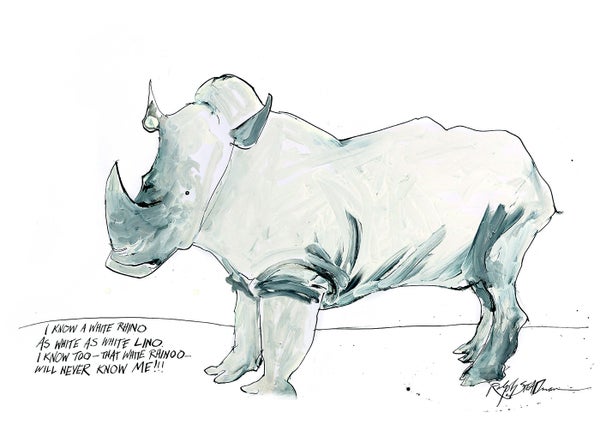
The white rhinoceros (Ceratotherium simum) is in big trouble. They live in Namibia, Zimbabwe, Kenya and South Africa with two subspecies: the “near threatened” southern white rhinoceros and the northern white rhinoceros, which is “critically endangered” and has become extinct in the wild. The two remaining individuals live in captivity in Kenya. Poaching for its horn for the Asian market, as with the black rhino, has seen the rapid descent of the species into a dark void.
After collaborating on two books showcasing extinct and endangered birds, legendary cartoonist Ralph Steadman and filmmaker Ceri Levy have paired up again to create this eccentric, wildly imaginative collection of illustrations of other critically endangered animals.
Steadman’s drawings are nonconformist, splotched with color and a delightful overlay of finger painting–like splashes and precise ink drawings. Levy's descriptions detail each creature’s environment and the threats to its survival. The depictions of insects—the little mother moth, the Greek red damsel, the monarch butterfly—are particularly lavish, and an eerie bleakness is infused in the portraits of the snow leopard and giant panda. Humorous correspondences between the two authors accompany the drawings, adding some lightheartedness to the heavy subject matter.
On supporting science journalism
If you're enjoying this article, consider supporting our award-winning journalism by subscribing. By purchasing a subscription you are helping to ensure the future of impactful stories about the discoveries and ideas shaping our world today.
Critical Critters by Ralph Steadman and Ceri Levy Bloomsbury Natural History, 2017
It’s Time to Stand Up for Science
If you enjoyed this article, I’d like to ask for your support. Scientific American has served as an advocate for science and industry for 180 years, and right now may be the most critical moment in that two-century history.
I’ve been a Scientific American subscriber since I was 12 years old, and it helped shape the way I look at the world. SciAm always educates and delights me, and inspires a sense of awe for our vast, beautiful universe. I hope it does that for you, too.
If you subscribe to Scientific American, you help ensure that our coverage is centered on meaningful research and discovery; that we have the resources to report on the decisions that threaten labs across the U.S.; and that we support both budding and working scientists at a time when the value of science itself too often goes unrecognized.