
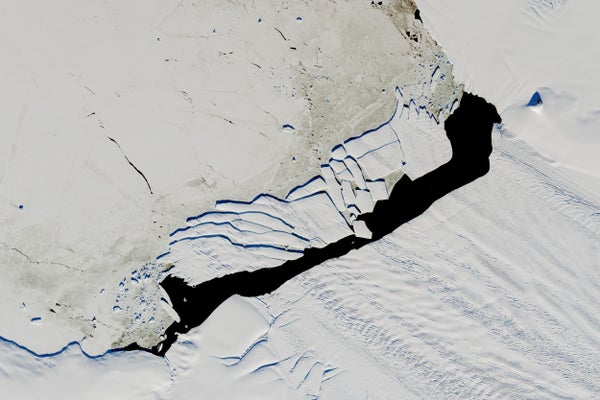
Antarctic glaciers may be capable of shrinking at much faster rates than scientists previously imagined — raising new concerns about the future of the ice sheet.
New evidence suggests that parts of the ice sheet retreated by as much as 6 miles a year at the end of the last ice age, around 11,000 years ago. That's about 10 times as fast as the fastest-melting glaciers are retreating today.
It's an ominous reminder that previous warm periods have driven monumental environmental changes — and it's possible it could happen again.
On supporting science journalism
If you're enjoying this article, consider supporting our award-winning journalism by subscribing. By purchasing a subscription you are helping to ensure the future of impactful stories about the discoveries and ideas shaping our world today.
"This is the first study that's showed definitively that rates [of retreat] can be this rapid," said lead author Julian Dowdeswell, director of the Scott Polar Research Institute at the University of Cambridge.
The study, published yesterday in Science, used a robotic underwater vehicle to investigate the seabed around the eastern Antarctic Peninsula. The vehicle revealed a pattern of ridges on the ocean floor, perfectly preserved for thousands of years.
These kinds of ridges can form as a glacier loses ice and retreats backward into the ice sheet.
Researchers believe ocean tides are a key part of the process. When the tide comes in, it rocks the glacier and ever-so-slightly lifts the ice from the bottom of the ocean. When the tide goes back out, the ice settles back into place.
A stable glacier will lift up and set down again in the exact same spot. But a glacier that's steadily losing ice will retreat backward, just a bit, each time the tide comes in and out. The result is a pattern of lines in the seafloor, marking how the ice has moved backward over time.
This explanation — relying on ocean tides as a pace-setter — is commonly accepted in the research community, according to Martin Jakobsson of Stockholm University, who published a comment on the new research in Science this week.
Assuming this is what was happening, the pattern suggests the ice in this region was retreating by 40 to 50 meters each day. Over an entire year, that would come to more than 10 kilometers, or at least 6 miles.
The researchers believe the high rates of retreat probably would have lasted no more than a few years before restabilizing.
Still, compared with present-day estimates of glacier retreat, it's an eyebrow-raising figure.
By contrast, Pine Island Glacier — one of the fastest-melting glaciers in Antarctica today — has retreated at a rate of just over a kilometer per year for the past few decades.
The new study doesn't prove exactly what processes were physically driving the retreat 11,000 years ago. It demonstrates that extremely rapid retreat is possible but doesn't explain what conditions are necessary for this to happen.
Dowdeswell said he believes the circumstances today might be similar to what was going on at the end of the last ice age.
Today, scientists believe that currents of warm ocean water are helping to melt Antarctica's fastest-melting glaciers from the bottom up. The warm water seeps beneath the ice shelves at the edges of the glaciers, causing them to thin and destabilize.
"The circumstances of ice shelf systems thinning were likely to be similar 11,000 or 12,000 years ago," Dowdeswell said.
But without a proven explanation for what was happening, the new study "presents a challenge for the ice-modeling community," Jakobsson wrote.
Scientists rely on models to help them predict how glaciers may behave in the future, such as when and where ice melt may begin to speed up and how much sea levels will rise in response.
But ice models are notoriously difficult to build, in large part because scientists still are scratching the surface of how ice sheets physically respond to climate change.
In recent years, multiple studies have begun to suggest that previous projections about sea-level rise may have been too low — that the world's ice sheets may melt at faster rates than previously predicted.
The new study would seem to add to these anxieties, Dowdeswell noted. It suggests that former estimates "don't encompass the full variability and full rapidity of the rates of retreat that can take place," he said.
Reprinted from Climatewire with permission from E&E News. E&E provides daily coverage of essential energy and environmental news at www.eenews.net.