
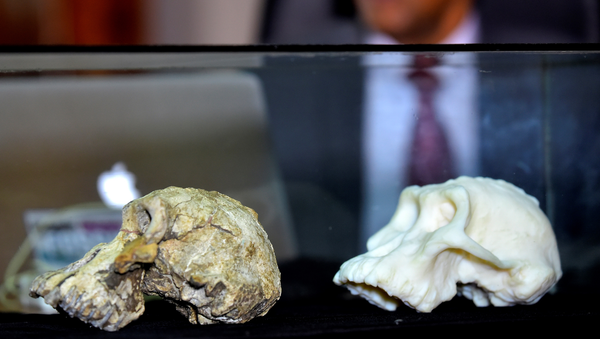
An ancient face is shedding new light on our earliest ancestors. Archaeologists have discovered a 3.8-million-year-old hominin skull in Ethiopia—a rare and remarkably complete specimen that could change what we know about the origins of one of humanity’s most famous ancestors, Lucy.
The researchers who discovered the skull say it belongs to a species called Australopithecus anamensis, and it gives researchers their first good look at the face of this hominin. This species was thought to precede Lucy’s species, Australopithecus afarensis. But features of the latest find now suggest that A. anamensis shared the prehistoric Ethiopian landscape with Lucy’s species, for at least 100,000 years, the researchers say. This hints that the early hominin evolutionary tree was more complicated than scientists had thought—but other researchers say the evidence isn’t yet conclusive.
“Fossil hominin crania are exceptionally rare treasures,” says Carol Ward, a palaeoanthropologist at the University of Missouri in Columbia who wasn’t involved in the analysis. “This to me is the specimen we have been waiting for.” An analysis of the skull is published in Nature.
On supporting science journalism
If you're enjoying this article, consider supporting our award-winning journalism by subscribing. By purchasing a subscription you are helping to ensure the future of impactful stories about the discoveries and ideas shaping our world today.
Exceptionally preserved
A. afarensis lived in East Africa between about 4 million and 3 million years ago. It is important to the understanding of human evolution because it might have been the ape-like species from which the ‘true’ human genus, Homo, evolved about 2.8 million years ago. Over the past few decades, researchers have discovered dozens of fragments of australopithecine fossils in Ethiopia and Kenya that date back more than 4 million years. Most researchers think these older fossils belong to the earlier species, A. anamensis. It’s generally thought that A. anamensisgradually morphed into A. afarensis, implying that the two species never coexisted.
The 3.8-million-year-old hominin skull, discovered at a site called Woranso-Mille in Ethiopia, now suggests otherwise. A team of palaeoanthropologists led by Yohannes Haile-Selassie at the Cleveland Museum of Natural History in Ohio discovered the specimen—called the MRD cranium—in 2016.
Features of the fossil’s teeth and jaws suggest that it belongs to A. anamensis. That’s an important conclusion because, until now, researchers had found only a few fragments of A. anamensis skulls.
“The preservation of the specimen really is exceptional,” says Stephanie Melillo, a palaeoanthropologist at the Max Planck Institute for Evolutionary Anthropology in Leipzig, Germany, who was involved in the latest work. The skull was found in just two large pieces, which she says is unfathomably unlikely for a specimen of this age. “We just got really lucky with this find.”
Coexistence?
The find makes it possible to reassess other australopith facial fossils, including a 3.9-million-year-old forehead fragment found in Ethiopia in the 1980s. Until now it wasn’t clear whether this fragment belonged to A. afarensis or A. anamensis. But now the researchers have been able to show that the fragment has features that are seen in younger A. afarensis skulls but are absent in the MRD cranium. Assuming the forehead fragment belonged to an A. afarensis individual, and the MRD cranium to an A. anamensis individual, the researchers suggest that the two species may have coexisted in the region for 100,000 years or more.
Haile-Selassie and his colleagues say it’s still likely that Lucy’s species evolved from A. anamensis. But they think it did so through a ‘speciation event’: perhaps a small group of A. anamensis became genetically isolated from the general population and evolved into A. afarensis, which eventually outcompeted the wider A. anamensis population.
Melillo admits that arguing for a local speciation event rather than the gradual transformation of the entire population might seem like splitting hairs, but she says that understanding exactly how hominin species evolved is a crucial first step to unravelling why they evolved the way they did.
Some researchers are ready to consider the possibility that A. afarensis and A. anamensiscoexisted. “It’s a very interesting claim,” says David Strait, a palaeoanthropologist at Washington University in St Louis, Missouri.
But both Strait and Ward think the evidence isn’t conclusive yet, because it rests heavily on just two fossils—the MRD cranium and the forehead fragment discovered in the 1980s. Strait thinks future fossil finds might help to firm up the idea.
Hominin neighbours
Tim White, a palaeoanthropologist at the University of California, Berkeley, thinks that with such limited evidence it’s far too soon to revise our understanding of Lucy’s origins. But he says that it is becoming more common for researchers to argue that there were two or more hominin species coexisting at any given point over the past several million years.
Haile-Selassie thinks that multiple hominin species did coexist between 3 million and 4 million years ago, and not just because of the MRD cranium. In 2012, he and his colleagues described a 3.4-million-year-old hominin fossil foot from Woranso-Mille with an opposable big toe. That’s a feature not seen in the hominins known to be alive at the time, implying that the foot belonged to a mysterious but distinct species that shared the landscape.
“The discoveries from the Woranso-Mille site have clearly demonstrated to me that there were multiple early hominin species,” says Haile-Selassie.
This article is reproduced with permission and was first published on August 28, 2019.