
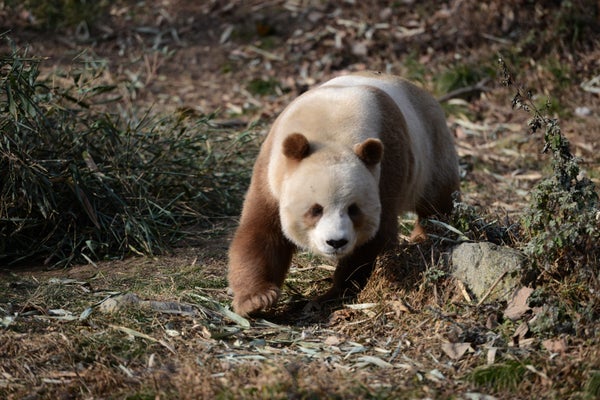
Not everything in life is always black and white. Neither are giant pandas.
For years, scientists — and the public — in China have been fascinated by Qizai, the only brown-and-white panda in captivity. Found abandoned in the wild, he lives at Louguantai Wild Animal Breeding and Protection Center in Xi’An. Only seven brown-and-white pandas have ever been documented — all from Qinling, a mountain range in the Chinese province of Shaanxi.
Now, a team of researchers has found out why the 14-year-old male bear has such unusual fur, with the findings also likely to apply to wild brown pandas.
On supporting science journalism
If you're enjoying this article, consider supporting our award-winning journalism by subscribing. By purchasing a subscription you are helping to ensure the future of impactful stories about the discoveries and ideas shaping our world today.
The brown pandas are missing a short sequence of DNA in Bace2, a pigmentation-related gene, according to a study published today by the Proceedings of the National Academy of Sciences.
Bears in brown
Qinling pandas are “rather different” from those in Sichuan — the province that most giant pandas (Ailuropoda melanoleuca) inhabit — according to Hu Yibo, a co-author of the paper.
“Previous studies suggested that Qinling pandas may have been separated from Sichuan pandas around 300,000 years ago,” says Hu, a conservation geneticist at the Institute of Zoology at the Chinese Academy of Sciences (CAS) in Beijing.
Hu and his colleagues studied the genomic information of three ‘family trios’ — a pair of panda parents and their cub — associated with two brown pandas, along with the genomes of 29 other black-and-white pandas.
The trios were Qizai and his parents; Qizai, his mate and their cub; and Dandan — the first brown panda to be documented in China, nearly four decades ago — her mate and their cub. Among them, only Qizai and the now-deceased Dandan are brown and white.
Missing information
The researchers believe that the brown pandas are homozygous for a particular version of Bace2 — that is, they have identical copies of the gene. Genetic sequencing confirmed that both copies of Bace2 in the brown bears were missing the same stretch of 25 base-pairs, the basic unit of a molecule of DNA or RNA. “This essentially means that the coding sequence for the protein is disrupted, which leads to a malfunction of the protein,” Hu explains.
Further genetic sequencing of 192 other black-and-white pandas in captivity showed that none was homozygous for this version of Bace2. In a lab experiment, mice genetically modified to have the mutation had light-coloured coats.
The team also found that when compared with the hairs of black pandas, the hairs of brown ones seem to have fewer and smaller melanosomes — organelles responsible for pigmentation of the hair and skin.
“The breakthrough of this paper is the finding that the missing of a gene or genetic segment could also lead to the change of colour,” says Shi Peng, an evolutionary geneticist at the CAS Kunming Institute of Zoology. “From a genetics perspective, this is a brand-new discovery.”
Hu and his colleagues plan now to investigate how the 25-base-pair deletion leads to changes in the size and number of melanosomes in brown pandas.
This article is reproduced with permission and was first published on March 4, 2024.