
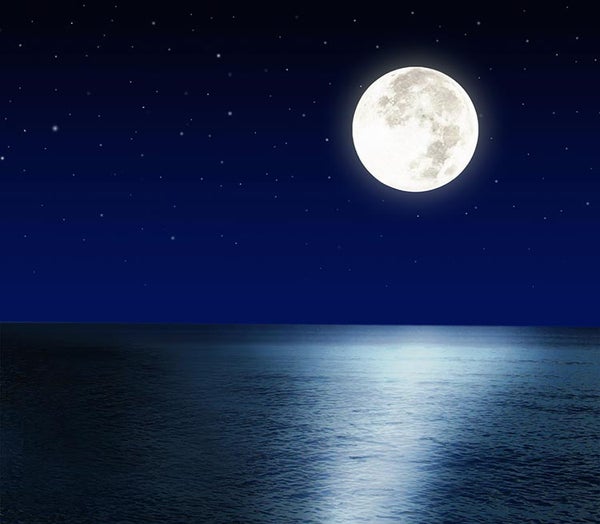
Holiday lights will adorn many neighborhoods this Christmas, but look out for a very special lighting treat in the form of a full moon this Friday.
This month, the full moon will peak at 6:11 a.m. EST (1111 GMT) on Dec. 25. This will be the first time a full moon has graced the skies on Christmas Day in 34 years, and it won't happen again until 2034.
When the December full moon rises, it will be a Full Cold Moon, because it will light up the sky during the beginning of winter, according to NASA. (In the Northern Hemisphere, astronomical winter kicks off on Dec. 21, the shortest day of the year.)
On supporting science journalism
If you're enjoying this article, consider supporting our award-winning journalism by subscribing. By purchasing a subscription you are helping to ensure the future of impactful stories about the discoveries and ideas shaping our world today.
Earth's closest neighbor is thought to have formed when a Mars-size rock collided with Earth, stripping off the outer layers. Since then, the moon has continued to affect the tides on Earth.
"As we look at the moon on such an occasion, it's worth remembering that the moon is more than just a celestial neighbor," John Keller, of NASA's Goddard Space Flight Center in Greenbelt, Maryland, said in a statement from the space agency. "The geologic history of the moon and Earth are intimately tied together, such that the Earth would be a dramatically different planet without the moon."
The online Slooh Community Observatory will host a free webcast of the Christmas full moon, and Comet Catalina, on Christmas Eve (Dec. 24) at 7 p.m. EST (0000 GMT). You can go to Slooh.com to join and watch the broadcast, which will run until midnight EST, and also see Slooh's library of past shows. You can also watch the broadcast here on Space.com, courtesy of Slooh.
Originally published on Space.com.
Copyright 2015 SPACE.com, a Purch company. All rights reserved. This material may not be published, broadcast, rewritten or redistributed.