
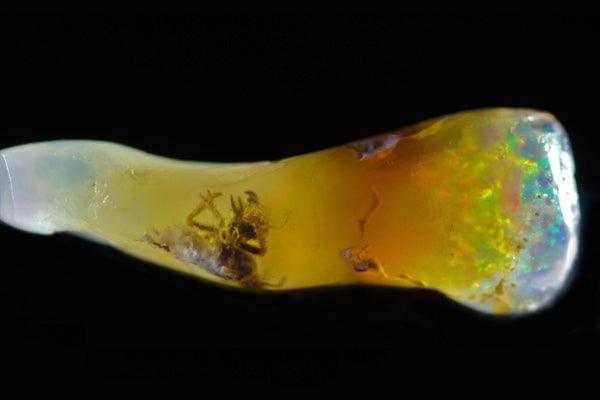
A bug trapped in a precious gem could offer new clues in the hunt for ancient life on Earth and Mars. The opal, pulled from rock in Indonesia and nicknamed “Beverly,” contains the shell of a tiny cicada nymph. In June in Scientific Reports, researchers explained how it likely formed.
Other opal fossils have been found among silica-containing rocks that form near geysers, says Boris Chauviré, a geologist at Grenoble Alpes University in France. Hot water dissolves these rocks; when the resulting silica-rich fluid cools, it can harden to form the shimmery gem—sometimes filling in spaces left by decayed organisms or trapping creatures' bodies. But this fossil comes from soil made by volcanic rocks eroding, and it is the first animal found entombed in opal that formed this way. Knowing this can happen, Chauviré says, suggests new places to look for ancient life.

Source: “Arthropod Entombment in Weathering-Formed Opal: New Horizons for Recording Life in Rocks,” by Boris Chauviré et al., in Scientific Reports, Vol. 10, Article No. 10575; 2020. https://doi.org/10.1038/s41598-020-67412-9
On supporting science journalism
If you're enjoying this article, consider supporting our award-winning journalism by subscribing. By purchasing a subscription you are helping to ensure the future of impactful stories about the discoveries and ideas shaping our world today.
This kind of opal formation is in fact more common than the hydrothermal process, but it is slower and thus considered less likely to preserve traces of life. But the team found a layer of zeolite, a silica-rich mineral, coating the exoskeleton; the researchers' analysis suggests that the substance crystallized on the shell while it was buried in soil and exposed to silica-carrying water, preserving its structure before the surrounding liquid eventually formed opal.
“This is the first time I've seen this type of preservation,” says Frances Westall, a geologist and astrobiologist at CNRS in Orléans, France, who was not involved in the study. She says the viability of this process—somewhat analogous to more common cases of insects preserved in amber, a fossilized tree resin—opens up more possibilities for finding evidence of ancient life. “The early Earth was a volcanic environment like Indonesia,” she says. “And so was early Mars.”
“Now we know that all kinds of silica can contain this kind of fossil or biomolecules,” Chauviré says. Opal fossils that formed in volcanic settings such as early Earth or early Mars could reveal ancient underground critters that are not typically preserved in sedimentary rock or amber, he adds: “The future Jurassic Park can be with opal, maybe.”