
CATCHING A CONSPIRACY
In “Inside the Echo Chamber,” Walter Quattrociocchi describes his and his colleagues' work on researching how conspiracy theories propagate online. The article reminds me of the elements necessary for an infection to successfully spread within a population. First, an agent must exceed a certain threshold of infectivity, a property called virulence. Second, vulnerable hosts must be available to become infected. If many in a population have acquired an immunity, then even if one person catches a given infection, it will be less likely to successfully propagate. Finally, there must be a vector or vehicle to physically spread the infectious agent. In this analogy, a certain audience may possess a host vulnerability to a given piece of misinformation, and the vehicle that spreads it is now ubiquitous in the form of social media.
RICH DAVIS Renton, Wash.
On supporting science journalism
If you're enjoying this article, consider supporting our award-winning journalism by subscribing. By purchasing a subscription you are helping to ensure the future of impactful stories about the discoveries and ideas shaping our world today.
I was surprised by the absence of a social psychologist among the breadth of disciplines represented in Quattrociocchi's own research group, although at least one was cited elsewhere. The results he described are consistent with social psychology research and theory dating back to the 1950s, and I would suggest that he add someone in that discipline to his team.
The echo chamber idea follows from social comparison theory (proposed by Leon Festinger in 1954), which tells us that when people want to learn the “truth” about issues, they look to others with whom they identify, typically those with like-minded beliefs and attitudes. The finding that debunking information actually increased conspiracy news consumption is exactly what cognitive dissonance theory (also proposed by Festinger, in 1957) would predict. When people perform an action consistent with their beliefs and are then confronted with information contradicting the implications of that action, they often resolve the contradiction by increasing the performance of the previous action.
CHARLES PAVITT Department of Communication, University of Delaware
TRIAL JUDGMENT
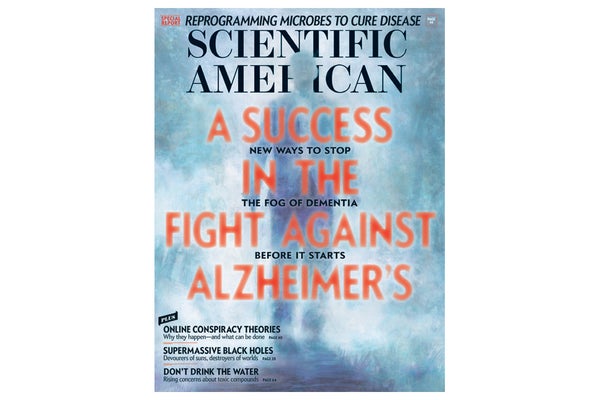
In “A Rare Success against Alzheimer's,” Miia Kivipelto and Krister Håkansson describe a clinical trial on improving cognition in subjects aged 60 to 77 that they are involved in. The 631 individuals in the treatment group were directed to follow a regimen of a particular diet, including a vitamin D supplement, exercise and cognitive training, and the control group received health advice. Both groups were followed for cardiovascular health. The treatment group showed significant improvement during the two years of the investigation, and the control group also showed improvement, to a lesser degree.
There is no way to know which of the measures produced the observed effect. For a scientific study, one would expect the outcome to have been compared with groups receiving only one of each intervention. Moreover, although the authors describe selecting subjects with a high possibility of developing dementia and report that those with a gene variant linked to Alzheimer's risk “seemed to receive somewhat more benefit,” the study did not involve any individuals who had the disease. It is disappointing that it thus did not truly address the possible effect these interventions might have on Alzheimer's. Obviously this is not possible with such a short study period, and it is comforting that the participants are now being followed for an additional seven years.
JENS CHRISTIAN JENSENIUS Professor emeritus, Department of Biomedicine, Aarhus University, Denmark
I have co-authored two Scientific American articles in the past, and I find that Kivipelto and Håkansson's study falls short of being “a gold-standard clinical trial,” as they state in their article. The authors' failure to cite the amounts of variance explained by each of their variables, independently or in conjunction with other variables, makes their conclusions equivocal. At best, their data confirm validity for a limited number of factors previously found in association with Alzheimer's but do not show that these are either primary causal factors or that they contribute to the disease with known amounts of impact (that is, the association may be purely incidental).
Further, with the gold-standard label of authenticity and the prestige of being a Scientific American cover story, this article could disturbingly imply that those suffering with this debilitating disease are, in some way, responsible for their condition—that had they maintained the specified diet, exercise routine, and so on, Alzheimer's could have been avoided. The risk of causal attribution may be said to exist in any research on factors associated with a medical condition, but avoiding it is of particular importance here because of the terrible burden on caretakers.
NATHAN S. CAPLAN Emeritus professor of psychology and emeritus research scientist, University of Michigan
ON THE RECORD
As a physician, I find that “A Better Reckoning” [Science Agenda]—the editors' opinion piece on improving death certificates in the U.S.—fails to address two important issues. First, what is the actual cause of death? The editors note inaccuracies such as recording lung cancer when a patient had ovarian cancer metastasized in the lung. But say my patient is admitted to the hospital with a pulmonary embolism and dies. Was the culprit the hypotension caused by the embolism? Or the thrombophlebitis that led to the embolism? Or the hypercoagulable state that led to the thrombophlebitis?
Second, how do you code a death when you don't actually know the cause? For example, my patient, who was obese, diabetic and hypertensive and had coronary artery disease, is found dead. The family declines an autopsy, and the coroner refuses to do one because nothing suggests foul play. I am required to record a cause of death. Should I say heart attack, respiratory failure or possibly pulmonary embolism?
Having more detailed death certificates is clearly needed, but we also have to address the issues of the lack of clarity in how, exactly, we should indicate causation and our inability to assign a specific cause when many are possible and there is insufficient evidence to choose among them.
ED COLLOFF via e-mail
ERRATA
“Quick Hits,” by Andrea Marks [Advances], reported that children younger than five have been nearly wiped out by malnutrition in Nigeria. It should have specified that this has occurred in Nigeria's state of Borno.
“Is there a link between music and math?” which appeared in Ask the Brains in the May/June 2017 issue of Scientific American Mind, has been updated online because of errors in the editing process. The revised version can be found at www.ScientificAmerican.com/article/is-there-a-link-between-music-and-math