
Key concepts
Physics
Potential energy
Kinetic energy
Conservation of energy
Introduction
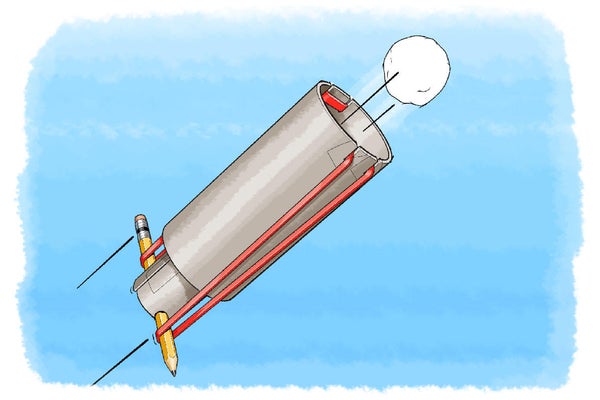
Have you ever stretched a rubber band and launched it? Put that energy to use and build a rubber band–powered cotton ball launcher in this fun activity!
Background
When you stretch a rubber band it stores elastic potential energy—the energy stored inside a material when it is stretched, squished, bent or twisted. This is different from gravitational potential energy, which is stored in an object that is lifted off the ground. Both types of potential energy can be converted to kinetic—the energy of motion. All moving objects have kinetic energy, but motionless ones have none. When energy is converted between forms the total amount of energy remains the same. In other words, it is conserved. (Some energy, however, may also be converted to heat due to friction—but that is still a form of energy.)
On supporting science journalism
If you're enjoying this article, consider supporting our award-winning journalism by subscribing. By purchasing a subscription you are helping to ensure the future of impactful stories about the discoveries and ideas shaping our world today.
In this activity you’ll explore conservation of potential and kinetic energy by measuring the distances you can launch a cotton ball using your own homemade launcher!
Materials
Short pencil or Popsicle stick
Two thin rubber bands
Two empty toilet paper tubes or one empty paper towel tube cut in half
Packing tape or other strong tape
Scissors
Cotton balls
Yardstick
Ruler
Three pieces of paper
Partner
Single-hole puncher (optional)
Preparation
Gather your materials in a clear, open area.
Use your yardstick to measure out a distance of three yards using a piece of paper to mark each yard. Place your yardstick in the first yard. This will be your launching station. How far do you think you will be able to launch your cotton balls?
Use your scissors to carefully cut one of the toilet paper tubes in half lengthwise.
Squeeze the roll so it becomes narrower (about half the original diameter) then tape it to hold it in place.
Use your scissors or your hole puncher to make two holes in the skinny tube. (If you’re using a popsicle stick, use scissors to make narrower holes the same shape as the popsicle stick.) Make the holes opposite each other, half an inch away from the end, so you can poke your pencil or popsicle stick all the way through the tube.
Carefully push your pencil or popsicle stick through the holes.
On your second toilet paper tube cut two slits into one end of the tube about one quarter inch long and one half inch apart.
Cut two more slits on the same end of the tube directly across from the first two.
Carefully loop one rubber band through the slits on one side so that it hangs from the cardboard piece in the middle. Put a piece of tape over the slits to reinforce the cardboard tab.
Loop the other rubber band through the slits on the other side of the tube. When you are finished the tube should have a rubber band hanging from each side.
Holding the rubber-band tube so its rubber bands are at the top, slide the narrower tube into the wider one with the pencil end at the bottom.
Carefully loop each rubber band end around the pencil.
Hold your launcher so that the pencil is at the bottom. Place a cotton ball on the top so that it rests inside on the narrower tube.
Procedure
Go to your launching station and stand next to the zero-end of the yardstick. Now that you have built your launcher, how far do you think your cotton ball will fly?
Hold your launcher slightly horizontally (without dropping the cotton ball). Have your partner hold the ruler next to your launcher.
Pull back on the pencil so the inner tube extends two inches out the back of the launcher. Carefully aim your cotton ball (away from people).
Release the pencil and watch your cotton ball fly!
Use your yardstick to measure the distance the cotton ball traveled.
Repeat the previous steps, each time pulling the launcher back one inch farther. When did the cotton ball the travel the shortest distance? When did it travel the farthest?
Extra: Try testing different rubber-band thicknesses and see which launch the farthest!
Observations and results
In this activity you used two types of energy to load and launch your cotton ball. As you drew back on the pencil with the cotton ball loaded you were adding potential energy to the system. The farther you pulled back on the pencil, the more potential energy was being stored. When you released the pencil the energy became kinetic and the cotton ball should have gone flying through the air!
The farther you pulled back on your launcher the more potential energy you added to the system—and the more you stored the more kinetic energy should have been released when you shot the cotton ball. As a result, the farther you pulled back on the launcher, the farther the cotton ball should have traveled.
More to explore
Rubber Bands for Energy, from Science Buddies
STEMonstrations: Kinetic and Potential Energy, from NASA
Snappy Science: Stretched Rubber Bands Are Loaded with Potential Energy, from Scientific American
Make Monkeys Fly in the Blink of an Eye, from Science Buddies
STEM Activities for Kids, from Science Buddies
This activity brought to you in partnership with Science Buddies
