
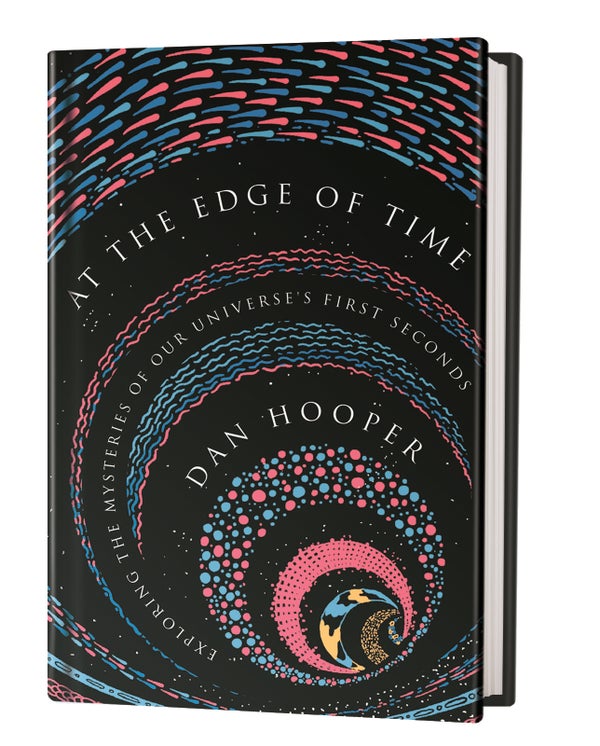
At the Edge of Time: Exploring the Mysteries of Our Universe's First Seconds
by Dan Hooper
Princeton University Press, 2019 ($24.95)
The first instants of the universe may seem like a blip on the cosmic time line, but this was probably the most important, formative era in history—and the most inscrutable. Scientists know precious little about what happened when the universe got its start: many cosmologists think space and time underwent an extremely rapid expansion called inflation, yet this theory raises as many questions as it answers. Learning more about this early epoch is the key to many of the most pressing conundrums in physics: What is dark matter? What drives dark energy? And why is the cosmos made of matter and not antimatter? Astrophysicist Hooper takes readers on a mind-bending expedition through these questions and shows how they all connect to the beginning. “Our universe's greatest mysteries,” he writes, “are firmly tied to its first moments.” —Clara Moskowitz
Unravelling the Double Helix: The Lost Heroes of DNA
by Gareth Williams
Pegasus, 2019 ($35)
On supporting science journalism
If you're enjoying this article, consider supporting our award-winning journalism by subscribing. By purchasing a subscription you are helping to ensure the future of impactful stories about the discoveries and ideas shaping our world today.
The central code for all life on Earth has captivated and confounded scientists for nearly a century. In this expansive tome, writer Williams charts the first 100 years of DNA research—Nobel Prizes won and lost, intriguing discoveries, scientific betrayal and colorful lesser-known characters. For instance, at age 25 Lawrence Bragg, who had been a child prodigy, and his father, William, won the 1915 Nobel Prize in Physics for their work in crystallography. The son later became the director of the lab where Watson, Crick, Franklin and Wilkins made their DNA discovery. Also featured are Florence Bell and William Astbury, who first attempted to model the structure of DNA in three dimensions (although their results didn't quite hit the mark). Through these accounts Williams paints the story of one of science's greatest achievements—unraveling the four-letter code that launched thousands of discoveries.—Jennifer Leman
On Trial for Reason: Science, Religion, and Culture in the Galileo Affair
by Maurice A. Finocchiaro
Oxford University Press, 2019 ($32.95)
Italian scientist and inventor Galileo Galilei was a pioneer in the experimental investigation of motion, devising the law of falling bodies and an approximate law of inertia, among many other hypotheses. In 1632 he published his book Dialogue on the Two Chief World Systems, in which he supported Copernicus's idea that Earth in fact was not stationary but orbited the sun. The next year he was summoned to Rome to stand trial for “suspicion of heresy.” Philosophy professor Finocchiaro presents a fascinating examination of these events and the ways Galileo's trial was essential in turning the Copernican hypothesis into accepted theory. It also birthed new strife between science and faith. The trial established how deeply skepticism of science was embedded in society. Galileo was convicted and sentenced to house arrest, where he continued his groundbreaking work until his death. He emerged from the affair as a cultural icon of reason and scientific thinking.
