
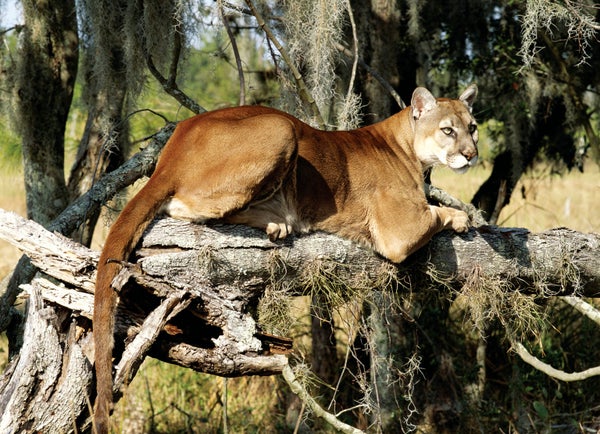
Cat Tale: The Wild, Weird Battle to Save the Florida Panther
by Craig Pittman
Hanover Square Press, 2020 ($27.99)
Florida once came very close to losing its state animal. By the 1980s decades of hunting and rapid development had pushed the Florida panther—the only subspecies of the North American cougar found east of the Mississippi River—perilously close to extinction. With a genial wit, journalist Pittman chronicles the extended saga of a few of the dedicated scientists who fought to bring these elusive and majestic animals back from the brink. The story is replete with interpersonal drama, lucky breaks, frustrating setbacks and bureaucratic decisions based on spurious science. Pittman’s tale would seem to have a happy ending: Florida’s panthers have experienced a remarkable baby boom thanks to a controversial breeding program. But the big cat is not out of the woods yet—it continues to lose habitat in a state where construction is often prioritized over conservation. —Andrea Thompson
The Scientist and the Spy: A True Story of China, the FBI, and Industrial Espionage
by Mara Hvistendahl
Riverhead Books, 2020 ($28)
On supporting science journalism
If you're enjoying this article, consider supporting our award-winning journalism by subscribing. By purchasing a subscription you are helping to ensure the future of impactful stories about the discoveries and ideas shaping our world today.
This story of international espionage begins in the unlikeliest of places—a cornfield in Iowa. In 2011 police caught three Chinese men trespassing on a farm that was partly under contract with agricultural giant Monsanto. The men were planning to dig up proprietary seeds to send back to China for reverse engineering—a scheme that, if successful, could have allowed China to reap huge profits from illegally duplicating Monsanto’s seed lines. Through skillful reporting, journalist Hvistendahl details the dramatic FBI investigation that followed, ultimately uncovering far more than corn-seed theft: a U.S. federal counterintelligence program intended to protect intellectual property that racially profiled and spied on ethnic Chinese scientists and students living and working in the States. —Sunya Bhutta
How We Learn: Why Brains Learn Better Than Any Machine . . . for Now
by Stanislas Dehaene
Viking, 2020 ($28)
The act of learning, cognitive psychologist Dehaene explains, is the construction of internal models of the outside world. Today the state of the art in artificial intelligence still pales against the powers of abstraction possessed by the human brain. For example, we—unlike most AI—can recognize a “chair” whether it has four legs or one or is made of metal or plastic. In this enlightening examination of the brain’s power to learn, Dehaene dispenses with the idea that the human brain is a tabula rasa, or blank slate, arguing that it comes preprogrammed by evolution. Babies are then like “budding scientists,” making hypotheses and gathering evidence to confirm or discard them. Such insights inform Dehaene’s proposed four “pillars” of learning, conditions that, if met, may maximize a human’s—or a machine’s—absorption of knowledge. —Tanya Lewis
What Stars Are Made of: The Life of Cecilia Payne-Gaposchkin
by Donovan Moore
Harvard University Press, 2020 ($29.95)
Overturning scientific dogma is no easy thing—especially as a marginalized minority. But that is just what Cecilia Payne-Gaposchkin did in the male-dominated field of early 20th-century astronomy, as detailed in this biography by journalist Moore. Growing up in London, Payne-Gaposchkin trained at the prestigious Cavendish Laboratory before finally landing at the Harvard College Observatory. There she analyzed spectral lines from stars for her 1925 doctoral thesis entitled “Stellar Atmospheres.” Defying preexisting theories, which held that stars’ compositions would mirror that of Earth’s crust, Payne-Gaposchkin’s studies showed hydrogen and helium to be their main ingredients. Though initially dismissed by some of her prominent male peers, her work was ultimately recognized as “the most brilliant Ph.D. thesis ever written in astronomy.”
