
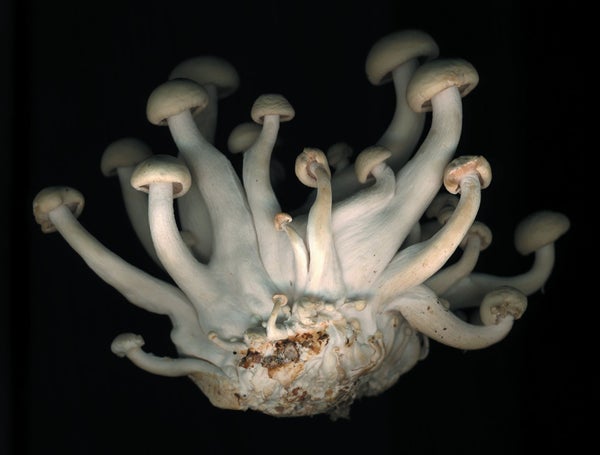
Entangled Life: How Fungi Make Our Worlds, Change Our Minds & Shape Our Futures
by Merlin Sheldrake
Random House, 2020 ($28)
Fungi make up an understudied kingdom of life-forms, often ignored unless they manifest as mushrooms, ferment a drink or rot a wood structure. But behind the scenes—and often belowground—fungi are the heavy lifters in complex nutrient exchanges and critical chemical reactions that sustain our more familiar world of plants and animals. In winding prose, biologist Sheldrake explores every aspect of what we know about these unusual beings. He documents impressive fungal feats, exploring how the organisms process toxic waste, synthesize medicines, build materials that act like leather, foam or concrete, and more—looking to a future where humans can harness fungi's ability to make new things and break down old things that nothing else can. —Sarah Lewin Frasier
The Planter of Modern Life: Louis Bromfield and the Seeds of a Food Revolution
by Stephen Heyman
W. W. Norton, 2020 ($26.95)
On supporting science journalism
If you're enjoying this article, consider supporting our award-winning journalism by subscribing. By purchasing a subscription you are helping to ensure the future of impactful stories about the discoveries and ideas shaping our world today.
As a Pulitzer Prize–winning author living in post–World War I France, Louis Bromfield cultivated friendships with luminaries such as Edith Wharton and Gertrude Stein—often by helping them cultivate their gardens. By the 1930s Bromfield's writing and movie career had made him rich enough to establish Malabar, a cooperative farm where he advocated for pesticide-free practices and soil conservation. Writer Heyman brings this champion of the organic food movement to life—for example, he vividly describes Bromfield's Indian tour, which included a visit to a soil institute and an all-night poker game with a maharani. With keen attention to detail, Heyman dusts off this forgotten figure who divided his time between filmic flashiness and farming. —Sophie Bushwick
The Idea of the Brain: The Past and Future of Neuroscience
by Matthew Cobb
Basic Books, 2020 ($32)
If you know nothing about neuroscience and need to get up to speed fast, don't go out and buy an “Idiot's Guide.” Instead try this brilliant offering, in which zoologist and science historian Cobb dives into the fundamentals—and the frontiers—of our understanding of the brain. For centuries scientists have compared the three-pound organ to a machine but have struggled to make the metaphor fit reality. “Even the simplest animal brain is not a computer like anything we have built, nor one we can yet envisage,” the author writes. Despite much progress in the field, he notes, we still lack a solid idea of how billions of neurons synchronize their signals to produce a myriad of brain activities. It may be centuries, Cobb posits, before we achieve a fundamental understanding of consciousness and other related mind mysteries. —Gary Stix
Girl Decoded: A Scientist’s Quest to Reclaim Our Humanity by Bringing Emotional Intelligence to Technology
by Rana el Kaliouby
Penguin Random House, 2020 ($28)
Is the Internet making us meaner? We have gotten used to hateful rhetoric and cruelty on the Web, but it can bleed into our real lives, too. Computer scientist el Kaliouby argues that society is facing an “empathy crisis,” a widespread inability to feel compassion. This engaging memoir traces her formative experiences as a Muslim woman in the Middle East and as a lead researcher at Cambridge. She co-founded a tech start-up with the mission to alter how people interact in the digital world. A pioneer in the field of artificial emotional intelligence, el Kaliouby focuses on teaching computers how to respond to the gamut of facial expressions, with the aim of devising tools that will humanize technology before it dehumanizes us. —Sunya Bhutta
