
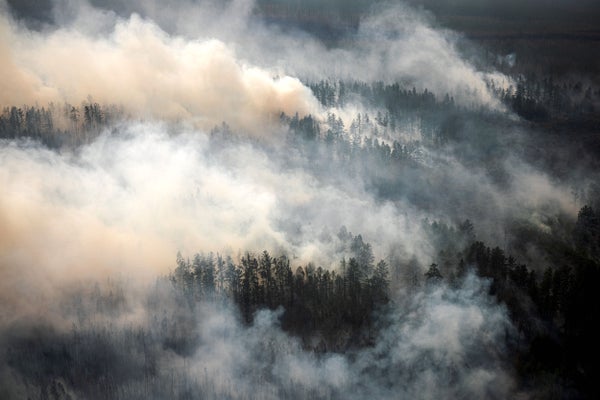
CLIMATEWIRE | Boreal forest fires in northern Eurasia and North America — including parts of Canada, Alaska and Siberia — spewed record-breaking levels of carbon dioxide into the atmosphere in 2021, new research finds.
In a typical year, these northern blazes account for about 10 percent of the planet’s wildfire-related carbon emissions. But in 2021, their share skyrocketed to 23 percent.
Heat and drought are likely to blame, the researchers say. Both North America and Eurasia experienced severe heat waves in the summer of 2021, and Eurasia also suffered low precipitation and drought conditions.
On supporting science journalism
If you're enjoying this article, consider supporting our award-winning journalism by subscribing. By purchasing a subscription you are helping to ensure the future of impactful stories about the discoveries and ideas shaping our world today.
And while 2021 shattered records for wildfire emissions, boreal fires have been worsening for decades alongside the changing climate. The research finds that emissions from these northern fires have been steadily creeping upward since at least 2000.
“Boreal forests could be a time bomb of carbon, and the recent increases in wildfire emissions we see make me worry the clock is ticking,” said study co-author Steven Davis, an earth system scientist at the University of California, Irvine, in a statement.
The new study, published Thursday in the journal Science, used satellite data to track wildfire emissions between 2000 and 2021.
Tracking fire-related carbon dioxide is important to climate scientists. These climate-warming emissions can speed the rate of global warming, further worsening the hot, dry conditions that drive wildfires.
But it can be difficult to directly measure fire-related carbon dioxide emissions using satellites, the researchers note. CO2 stays in the atmosphere for a long time, making it challenging to pinpoint where it originally came from.
But carbon monoxide, another type of wildfire emission, is another story. Carbon monoxide has a much shorter lifetime in the atmosphere and is much easier to directly attribute to wildfires. Scientists can observe the amount of carbon monoxide released by a fire and then use those measurements to estimate the amount of carbon dioxide that was released alongside it.
The researchers, led by Bo Zheng of Tsinghua University in China, used this special method to estimate carbon dioxide emissions from boreal forest fires. In 2021, they found, boreal fires poured nearly half a billion tons of carbon into the atmosphere.
Boreal fires, in general, are a growing cause of concern to climate scientists. They often occur on peaty, carbon-rich landscapes and tend to produce more carbon dioxide than other ecosystems when they burn.
That means they have a higher potential to influence the global climate and to get trapped in vicious feedback cycles — more fires release more carbon, which drives more warming, which drives more fires.
“These fires are two decades of rapid warming and extreme drought in Northern Canada and Siberia coming to roost, and unfortunately even this new record may not stand for long,” Davis said in a statement.
Reprinted from E&E News with permission from POLITICO, LLC. Copyright 2023. E&E News provides essential news for energy and environment professionals.