
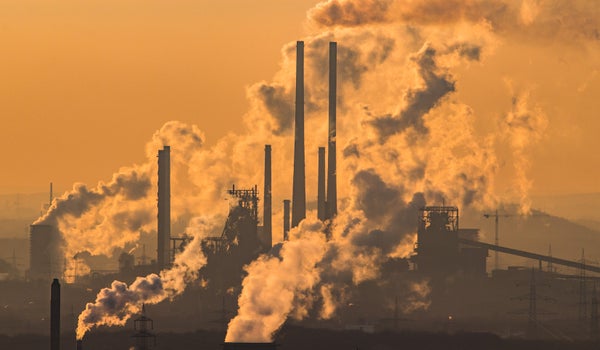
CLIMATEWIRE | Greenhouse gases trapped 49 percent more heat in 2021 than in 1990, as emissions continued to rise rapidly, according to NOAA.
NOAA released its “Annual Greenhouse Gas Index” last week. The index is based on thousands of air samples collected globally over each of the last 63 years; this observational method means it “contains little uncertainty,” according to the agency.
“Our data show that global emissions continue to move in the wrong direction at a rapid pace,” said NOAA Administrator Rick Spinrad.
On supporting science journalism
If you're enjoying this article, consider supporting our award-winning journalism by subscribing. By purchasing a subscription you are helping to ensure the future of impactful stories about the discoveries and ideas shaping our world today.
NOAA found that carbon dioxide, the most plentiful and long-lived gas, expanded at the most rapid rate over the last 10 years. But the most potent global warmer also broke records: methane increased more than it has since at least the early 1980s, when NOAA began its current measuring record. The methane emitted in 2021 was 15 percent greater than in the 1984-2006 period, and 162 percent greater than preindustrial levels, NOAA found.
Two-thirds of methane emissions come from raising farm animals such as cows and also from microbes in wetlands that are growing warmer because of CO2, said Stephen Montzka, a research chemist who prepares a report on the Index annually for NOAA’s Global Monitoring Laboratory. That combination can be hard to mitigate, as can nitrous oxide, a greenhouse gas that is mostly emitted by fertilizer, meaning reducing it could affect food supply.
But a third of methane comes from a source that humans can control, Montzka said: oil and gas production. Methane is 30 times more potent than CO2 as a warmer, but only lasts about nine years to CO2’s centuries.
So far, “there is no indication that methane is decreasing anywhere in the world because of mitigation,” Montzka said, “but in some regions, we are in a position to be looking for that.”
A report released this month by the American Physical Society asserted that “the United States is not effectively monitoring methane emissions from oil and gas operations.”
Forecasting climate change impacts
Beyond methane, nitrous oxide and CO2, NOAA counts 18 other chemicals as global warmers that have emerged since 1750, the onset of the Industrial Revolution. They include two, called chlorofluorocarbons, that are man-made super warmers that have been banned by treaties.
As these greenhouse gas emissions accumulate, climate change impacts are multiplying, in the form of more frequent extreme weather such as droughts, wildfires and heat waves. Researchers are thus testing out more ways to forecast such events — including using artificial intelligence or powerful computers to find predictive patterns in large amounts of data.
Officials at the National Center for Atmospheric Research (NCAR), for example, recently developed a method to forecast peak fire seasons “several months” before they developed. NCAR used machine-learning techniques on every wildfire since 1984 to discover that the growing dryness of the air in winter and spring preceded the summer expansion of wildfires.
For droughts, researchers at the University of Colorado Boulder found that the distribution of new, cheaper — but also more accurate — detectors could deliver better estimates of dwindling water supplies. The devices, about the size of two credit cards, can be placed yards away from streams, and use high-frequency radio waves to measure the depth of the water.
The proliferation of the devices, which don’t need experts to install them, could give communities “more insight into their water usage and supply over time” and could be used to develop difficult policy decisions about future water usage, according to the university’s Cooperative Institute for Research in Environmental Studies, which frequently partners with NOAA laboratories.
Reprinted from E&E News with permission from POLITICO, LLC. Copyright 2022. E&E News provides essential news for energy and environment professionals.