
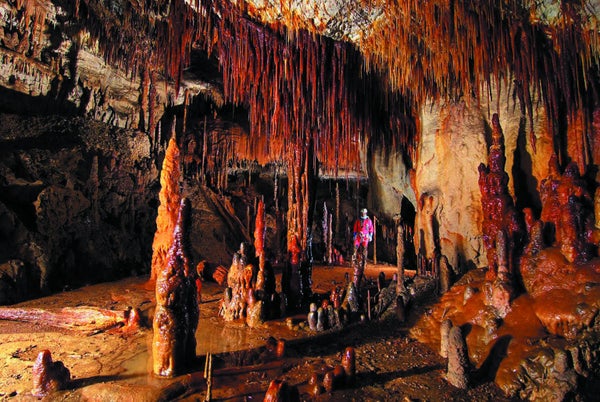
Not far from the famously multihued architecture of Bilbao in northern Spain, an underground world boasts its own vibrant display of color. The stalagmites and stalactites of Goikoetxe Cave are not just the usual white; many range from honey to deep red. New research shows that these formations, known generally as speleothems, get their red color from organic compounds leached from soil and transported by water. Scientists suggest, in an article published online in April in Quaternary International, that Goikoetxe Cave's speleothems record environmental conditions such as rainfall.
Virginia Martínez-Pillado, a paleoclimatologist at the Atapuerca Research Group and the UCM-ISCIII Center for Human Evolution and Behavior in Madrid, hiked and crawled through Goikoetxe Cave to reach its sala roja (“red chamber”). “All around you is red,” Martínez-Pillado says of the cavernous room covered in stalagmites and stalactites. She and her colleagues collected four stalagmites rising from the cave floor and brought them back to the laboratory. The team analyzed trace elements in them and ruled out iron oxidation, which often causes red coloration. (Think Mars.)
A reddish hue can also derive from organic materials, so the scientists next checked the stalagmites' molecular makeup. By measuring how the speleothems scattered and absorbed light, the researchers found that they contained humic and fulvic acids. These complex molecules form from decomposed plant debris, and the team concluded they must have been picked up by water and deposited on the stalagmites as they grew over thousands of years.
On supporting science journalism
If you're enjoying this article, consider supporting our award-winning journalism by subscribing. By purchasing a subscription you are helping to ensure the future of impactful stories about the discoveries and ideas shaping our world today.
The stalagmites could therefore point to past environmental conditions. Changes in rainfall, for instance, would affect the amount of organic matter flushed into the cave, says Alison Blyth, a geochemist at Curtin University in Perth, Australia, who was not involved in the study: “If we measure the chemical signals preserved in each layer, we can reconstruct how different environmental parameters have changed over time.” Martínez-Pillado and her colleagues are now analyzing the stalagmites to trace ancient variations in rainfall and vegetation above Goikoetxe Cave. This technique can also be applied to other caves with speleothems rich in organic matter, the researchers say.