
The kilogram is shrinking.
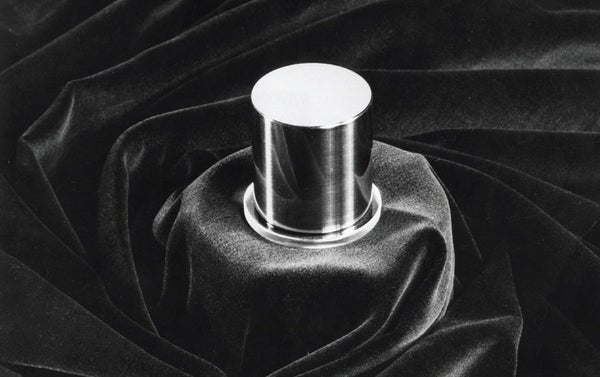
The official object that defines the mass of a kilogram is a tiny, 139-year-old cylinder of platinum and iridium that resides in a triple-locked vault near Paris. Because it is so important, scientists almost never take it out; instead they use copies called working standards. But the last time they did inspect the real kilogram, they found it is roughly five parts in 100 million heavier than all the working standards, which have been leaving behind a few atoms of metal every time they are put on scales. This is one of the reasons the kilogram may soon be redefined not by a physical object but through calculations based on fundamental constants.
“This [shrinking] is the kind of thing that happens when you have an object that needs to be conserved in order to have a standard,” says Peter Mohr, a physicist at the National Institute of Standards and Technology (NIST), who serves on the committee that oversees the International System of Units (SI). “Fundamental constants, on the other hand, are not going to change over time.”
On supporting science journalism
If you're enjoying this article, consider supporting our award-winning journalism by subscribing. By purchasing a subscription you are helping to ensure the future of impactful stories about the discoveries and ideas shaping our world today.
The redefinition of the kilogram will be part of a planned larger overhaul to make SI units fully dependent on constants of nature. Representatives from 57 countries will vote on the proposed change this month at a conference in Versailles, France, and the new rules are expected to pass. Along with the kilogram, the ampere (the unit of electric current), kelvin (temperature) and mole (amount of a substance) will get new definitions. The four will be based on Planck's constant, the elementary charge, the Boltzmann constant and the Avogadro constant, respectively. All these constants are determined by laboratory measurements, which have some inherent uncertainty. But if the vote is successful, countries using SI will agree on a fixed value for each constant based on the best data available and use them to derive the units.
What will happen to the old kilogram artifacts after the redefinition? Rather than packing them off to museums, scientists plan to keep studying how they fare over time. “There is so much measurement history on these,” says physicist Stephan Schlamminger of NIST. “It would be irresponsible to not continue to measure them.”