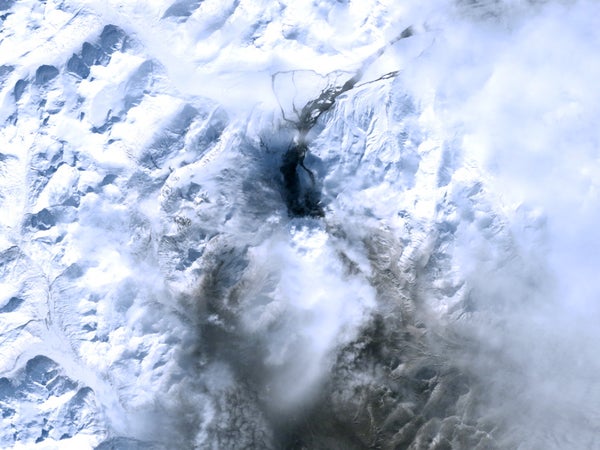
On March 22, Alaska's Mount Redoubt erupted for the first time in 20 years, a violent event followed by a number of smaller emissions.
NASA image created by Jesse Allen, using data provided courtesy of the USGS Land Remote Sensing Program
Join Our Community of Science Lovers!
On supporting science journalism
If you're enjoying this article, consider supporting our award-winning journalism by subscribing. By purchasing a subscription you are helping to ensure the future of impactful stories about the discoveries and ideas shaping our world today.
On March 22, Alaska's Mount Redoubt erupted for the first time in 20 years, a violent event followed by a number of smaller emissions. Last Thursday it again erupted dramatically, this time spewing forth a cloud some 11 miles (18 kilometers) tall, according to pilot reports cited by the Alaska Volcano Observatory (AVO). That day Mount Redoubt was caught in the act by Landsat 5, a 25-year-old workhorse satellite used by NASA and the U.S. Geological Survey for Earth observation. The volcano's plume of steam is visible in the center of the photograph; the dark curve leading upward from the plume is lahar (volcanic debris mixed with meltwater) streaming through the Drift River Valley. For more images of the valley following the initial eruption, see our slide show of Redoubt photos from the AVO.
It’s Time to Stand Up for Science
If you enjoyed this article, I’d like to ask for your support. Scientific American has served as an advocate for science and industry for 180 years, and right now may be the most critical moment in that two-century history.
SciAm always educates and delights me, and inspires a sense of awe for our vast, beautiful universe. I hope it does that for you, too.
If you subscribe to Scientific American, you help ensure that our coverage is centered on meaningful research and discovery; that we have the resources to report on the decisions that threaten labs across the U.S.; and that we support both budding and working scientists at a time when the value of science itself too often goes unrecognized.