
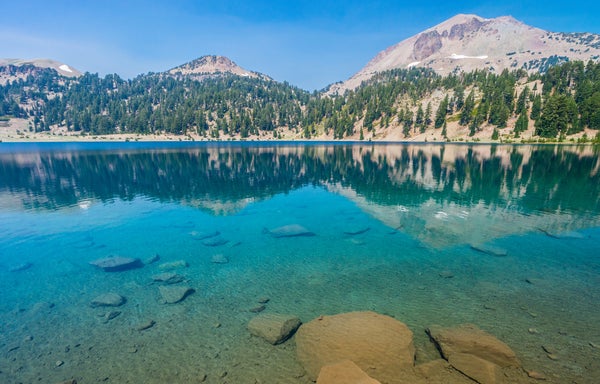
Nearly 14,000 high-elevation lakes in California's Sierra Nevada are showing acute stress from global warming, and their best chance at survival depends on the ability to stay under snow and ice in the spring.
New research published by the University of California, Davis, shows that the summer air at Emerald Lake, a long-term study site within Sequoia National Park, is warming at a rate of 1.5 degrees Fahrenheit per decade, one of the highest warming rates in the world but consistent with what has been seen in other mountainous regions.
But the small alpine lakes — prized for their rugged remoteness and mirrorlike surfaces — are partly buffered from warming air because they primarily respond to variations in snowpack, which acts as a kind of blanket against higher temperatures.
On supporting science journalism
If you're enjoying this article, consider supporting our award-winning journalism by subscribing. By purchasing a subscription you are helping to ensure the future of impactful stories about the discoveries and ideas shaping our world today.
"That's not to say that there is no climate warming signal," said Steven Sadro, a UC Davis assistant professor of environmental science and policy and a member of the Tahoe Environmental Research Center. "In drought years, when the role of snow is small, we find a warming trend consistent with the rate of warming found in other lakes throughout the world."
The findings come as a flurry of recent studies indicate snowpack across the Western U.S. is substantially declining (Climatewire, Dec. 13).
One recent analysis of snowpack data going back to 1982, published in the journal Geophysical Research Letters, found that about 13 percent of all snowy areas in the West have lost large amounts of snow over the last few decades, declining by 41 percent on average.
Researchers have also noted that the snow season is growing shorter across mountain regions, shrinking by an average of 34 days across 10 percent of the country since the 1980s. Among the reasons cited for the shorter snow season: Spring temperatures are arriving earlier in the West.
A UC Davis companion study published earlier this year, also on Emerald Lake, found that changes in snowpack also affect nutrient delivery and phytoplankton growth in Sierra Nevada lakes. The effects of phytoplankton increases in the lakes remain unclear, however.
"More phytoplankton could mean more food for lake organisms," the researchers said, "but it could also impact lake clarity, which is also an indicator of ecosystem health."
The group's latest research is published in the journal Limnology and Oceanography Letters.
UC Davis researchers and colleagues, organized under the California Mountain Lake Observatory Network, have recently improved measurement tools in nearly 20 Sierra Nevada lakes, from Castle Lake in Northern California to Emerald Lake in the southern reaches of the mountains.
"Castle and Emerald lakes are both long-term study sites, and together they provide unique bookends to the entire Sierra Nevada mountain range," Sadro said. "We're trying to fill in everything in between to better predict how lakes across the Sierra are expected to change."
Reprinted from Climatewire with permission from E&E News. E&E provides daily coverage of essential energy and environmental news at www.eenews.net.