Refurbished Hubble Space Telescope returns new images
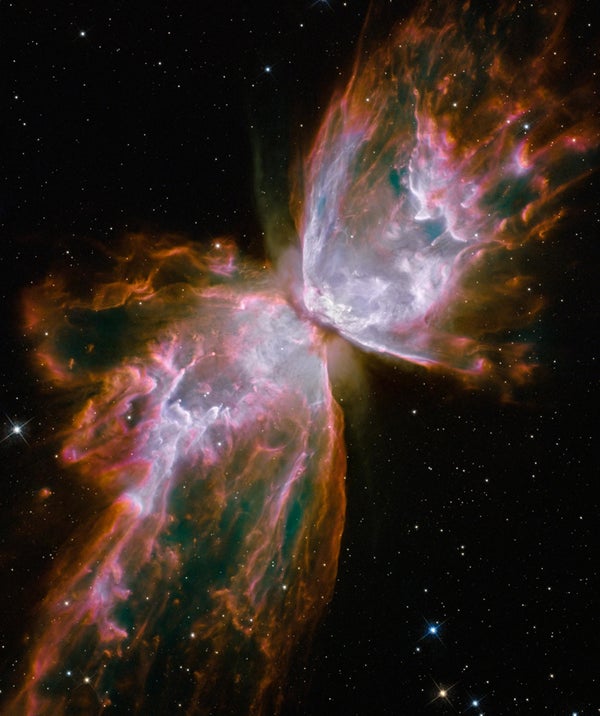
The Butterfly nebula, formally designated NGC 6302, is a planetary nebula roughly 3,800 light-years from the sun .
NASA, ESA, and the Hubble SM4 ERO Team
Join Our Community of Science Lovers!
On supporting science journalism
If you're enjoying this article, consider supporting our award-winning journalism by subscribing. By purchasing a subscription you are helping to ensure the future of impactful stories about the discoveries and ideas shaping our world today.
The Butterfly nebula, formally designated NGC 6302, is a planetary nebula roughly 3,800 light-years from the sun. The term planetary nebula is something of a misnomer, which arises from the fact that they are often round and resemble planets in low-resolution observations. But in fact planetary nebulae have nothing to do with planets—they are luminous clouds thrown off by dying stars.
The extended lobes of the Butterfly nebula are only a few thousand years old but were ejected with such high speed from their star that the nebula already spans more than two light-years.
If you enjoyed this article, I’d like to ask for your support. Scientific American has served as an advocate for science and industry for 180 years, and right now may be the most critical moment in that two-century history.
SciAm always educates and delights me, and inspires a sense of awe for our vast, beautiful universe. I hope it does that for you, too.
If you subscribe to Scientific American, you help ensure that our coverage is centered on meaningful research and discovery; that we have the resources to report on the decisions that threaten labs across the U.S.; and that we support both budding and working scientists at a time when the value of science itself too often goes unrecognized.