
Knock, knock—it's Opportunity. That's right, Curiosity isn't the only rover in town. Back in 2004 the twin rovers Spirit and Opportunity landed on the Red Planet for 90-day missions that have been extended by several years. After a scientifically fruitful stint, Spirit became mired in sand and ceased communicating with Earth in 2010, but Opportunity is still slowly exploring the Martian surface. Long before car-sized Curiosity stole the show, NASA had been using the much smaller rovers to gather data about whether Mars could support life.
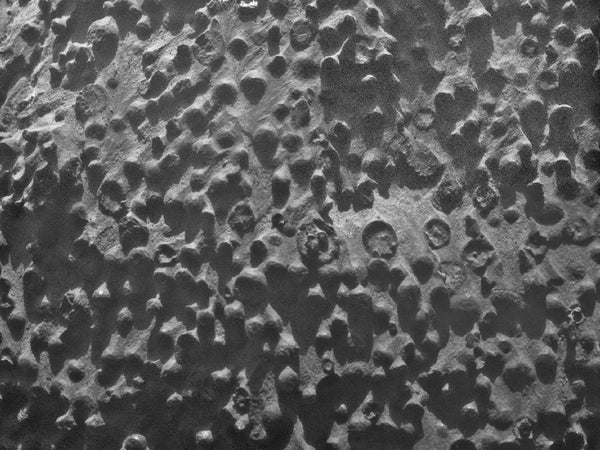
Not to be outdone by the newcomer, Opportunity is looking at the Kirkwood outcropping on the western rim of Endeavour Crater, on the opposite side of the planet from Curiosity. (There are no plans for the two rovers to rendezvous.) Opportunity snapped this image of tiny, rounded "spherules" on September 6 using the microscopic imager on its arm, one of its many built-in scientific instruments. This view is only 60 millimeters across, and is made up of four images stitched together. The largest of these intriguing spherules in the picture are about 3.175 millimeters in diameter.
Opportunity is no stranger to teensy, globular Martian formations. Back in 2004, it found hematite-rich spheres dubbed "blueberries" near its landing site. Those formations may have been caused by long-ago liquid water. Opportunity has been studying the newly discovered spherules with one of its tools, the Alpha Particle X-Ray Spectrometer. The mysterious, new bumps are different in composition from the blueberries, and scientists don't yet have a prevailing theory on their origin.
On supporting science journalism
If you're enjoying this article, consider supporting our award-winning journalism by subscribing. By purchasing a subscription you are helping to ensure the future of impactful stories about the discoveries and ideas shaping our world today.
—Evelyn Lamb