
On supporting science journalism
If you're enjoying this article, consider supporting our award-winning journalism by subscribing. By purchasing a subscription you are helping to ensure the future of impactful stories about the discoveries and ideas shaping our world today.
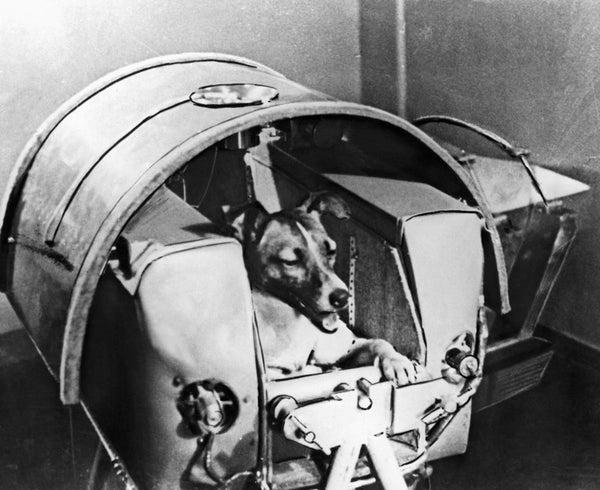
On November 3, 1957, the Soviet Union sent Laika, a stray dog picked off the streets of Moscow, on a one-way trip to space. Riding into orbit on Sputnik 2, Laika had one mission: to gauge whether space travel was fit for humans. She was the first animal ever to orbit Earth.
Laika was a cheap, less risky alternative to sending a person into the perilous, unknown realm of weightlessness. Years before cosmonaut Yuri Gagarin made history as the first person to launch into space in 1961, scientists questioned the human body’s ability to survive long stretches of time sans gravity.
Before Laika, American and Russian scientists experimented with shooting monkeys, chimps, rabbits, mice and rats into space. Generally they never returned. Small dogs like Laika, however, were ideal models for designing cabins that would eventually carry humans. Dogs were reportedly less fidgety than monkeys in flight. According to NASA, female dogs were preferred because of the “relative ease of controlling [their] waste.”
Laika’s real name was Kudryavka, which means “Little Curly.” She was a small mutt—eventually dubbed “Muttnik” by American reporters—who was quickly trained and strapped into a metal container on the second Sputnik sphere. The hastiness of her trip sadly meant that there was no time to plan her return. She reportedly died from overheating after only a few hours.
Sputnik 2 eventually burned up in the outer atmosphere in April 1958, leaving behind Laika’s legacy as one of the most charismatic, cuddly cosmonauts to bequeath her life in the service of science.
—Julia Calderone