
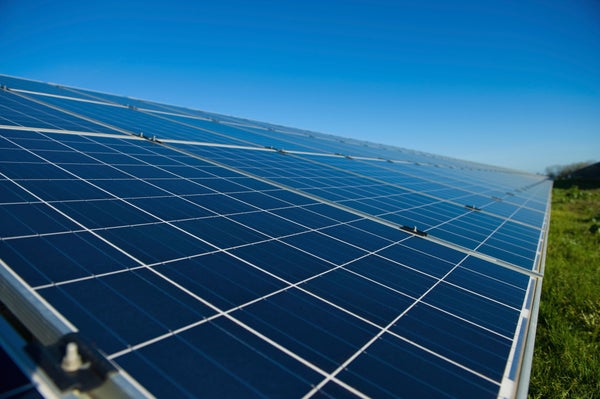
Renewable energy is now cheaper than natural gas and coal in parts of the United States. The only problem: Cheap renewables may not be enough to stop the world from warming to dangerously high levels.
The dynamic is outlined in a pair of recent reports. The first, by the financial advisory firm Lazard Frères & Co. LLC, finds wind and solar costs have declined by 69 percent and 88 percent, respectively, over the last nine years. In some parts of America, renewables don’t need subsidies to outcompete fossil fuels.
That should be music to the ears of climate hawks.
On supporting science journalism
If you're enjoying this article, consider supporting our award-winning journalism by subscribing. By purchasing a subscription you are helping to ensure the future of impactful stories about the discoveries and ideas shaping our world today.
Yet the International Energy Agency’s (IEA) annual World Energy Outlook outlines the scope of the challenge facing greens. The agency projects global energy demand will rise 25 percent through 2040 if it stays on its current trajectory.
Even more vexing for would-be carbon cutters: The average coal plant in Asia is 11 years old, meaning emissions from the sector will likely be locked in for decades to come, even as older American plants are retiring.
“If we’re trying to avoid the absolute worst and scariest impacts of climate change, we should be transforming the energy system far faster than we are on the economics alone,” said John Larsen, director of power sector and energy systems research at the Rhodium Group.
The IEA’s findings serve as a powerful reminder that the dynamics playing out in America’s power sector are not mirrored everywhere.
In the U.S., coal plant retirements in 2018 are nearing record highs, even as President Trump works to lessen the burden of environmental regulations (Climatewire, March 15).
The Lazard report shows why. The levelized cost of energy—the total cost of building and running a power plant over its lifetime—for an onshore wind farm ranges from $29 per megawatt-hour to $56. Utility-scale solar costs are $36-$44 per MWh. And those numbers continue to decline. Average wind and solar costs fell by 7 and 13 percent from 2017 levels.
By contrast, the cost of a coal plant was $60-$143 MWh while a combined-cycle natural gas plant registered at $41-$74 MWh.
“Although diversified energy resources are still required for a modern grid, we have reached an inflection point where, in some cases, it is more cost effective to build and operate new alternative energy projects than to maintain existing conventional generation plants,” George Bilicic, vice chairman and global head of Lazard’s Power, Energy & Infrastructure Group, said in a statement.
The IEA expects renewable growth to continue. It estimates renewables will account for two-thirds of all new power plant additions by 2040, growing from 25 percent of global electricity generation today to 40 percent.
The report also lays out the challenges facing the world when it comes to tackling emissions. To keep up with rising oil demand, crude production would have to grow by 10 million barrels a day through 2025. That’s roughly equivalent to Russian oil output, the world’s third-largest crude producer.
The demand comes despite projected gains by electric vehicles. In fact, it is being driven by the petrochemical, shipping and aviation sectors, areas of the economy almost completely reliant on petroleum products.
“The fastest growing petroleum demand is the hardest to address from a climate perspective,” said Larsen, noting other alternatives are not readily available in those sectors.
Meanwhile, the IEA estimates that coal will still account for a third of total global emissions in 2030, driven by projects in Southeast Asia. That’s one reason why the IEA sees global emissions edging higher in the future. Carbon emissions climbed 1.4 percent in 2017 (Climatewire, March 23).
The IEA’s analysis shows that 70 percent of all new energy investment will be government-driven.
“This means that if the world is serious about meeting its climate targets then, as of today, there needs to be a systematic preference for investment in sustainable energy technologies,” IEA Executive Director Fatih Birol said in a statement.
Reprinted from Climatewire with permission from E&E News. E&E provides daily coverage of essential energy and environmental news at www.eenews.net.