
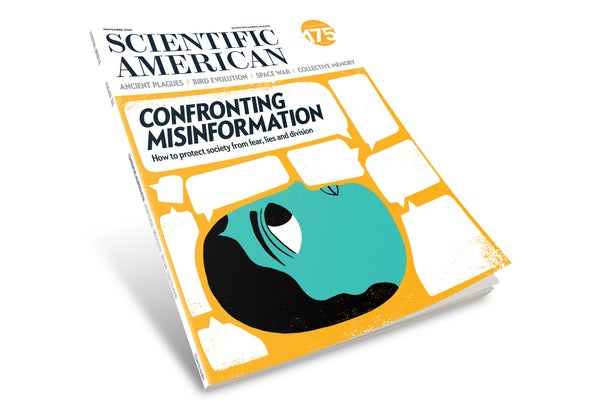
This month I learned that senior editor Jen Schwartz is an evil genius at media manipulation. She produced our cover package about misinformation, including a story about her own role in an Election Day drill in which she demonstrated how easily bad actors can disrupt honest news coverage. It's funny and chilling and a little too real for comfort, and I'm more grateful than ever that she is working for the side of truth and reality rather than disinformation.
Misinformation is one of the hottest areas of research right now—unfortunately because there's just so much to study. With the pandemic, election season, trolls who weaponize confusion and the massive influence of social media platforms, conspiracy theories and quackery are spreading more quickly and widely than ever. We hope that understanding the science of misinformation will help us all tell sense from nonsense and find the best ways to resist and debunk dangerous myths.
During the pandemic shutdown, lots of people are discovering the joy of watching birds. Senior editor Kate Wong was inspired by the goldfinches at her feeder to look into how birds evolved such spectacular diversity. As a longtime birder, I'm delighted to see this hobby becoming more popular. It's now hawk migration season, so when you're outdoors, look up, and you might see raptors heading south in a hurry.
You might not expect a story about space war to be ... charming? And amusing? Satellites fighting satellites is a serious issue, and science writer Ann Finkbeiner is a serious person, but she also knows how to bring out the absurdity of a situation and get experts to tell us what they really think. Enjoy an amazing graphic within.
Rocket science may be challenging, but brain science is immeasurably more complicated. Journalist Diana Kwon offers a possible explanation for how psychological trauma can cause neurological symptoms in a feedback loop that scientists are just starting to piece together. The mysterious condition is called functional neurological disorder.
At a time when every conversation eventually turns to the pandemic, it's hard to imagine that we will ever forget it. But collective memory for the catastrophic influenza of 1918–1919, which killed 50 million to 100 million people, was shockingly fleeting. The story is by Scott Hershberger, a summer writing fellow who worked with us through a program from the American Association for the Advancement of Science.
Plenty of other plagues have shaped history, and researchers around the world are extracting pathogens’ genetic material from their victims to show which diseases caused the worst mass deaths and how the germs spread around the world. The article by science writer James P. Close begins here. We hope that looking at the history of past plagues can help us understand the COVID-19 pandemic, which will only be ended with science, public health measures and a shared interpretation of reality.
We got more attention than we expected for our editorial in last month's issue endorsing Joe Biden for president. More than 1,000 publications covered the endorsement, and the response was overwhelmingly positive (whew). Thanks very much to everyone who sent supportive messages, including some people who disagree with the decision but respect us for feeling a responsibility to speak up. We hope those who are disappointed in the endorsement will stick with us for everything else we have in common: a desire to understand the world, share knowledge and discoveries, and show that reality is more rich and fascinating than misinformation.