
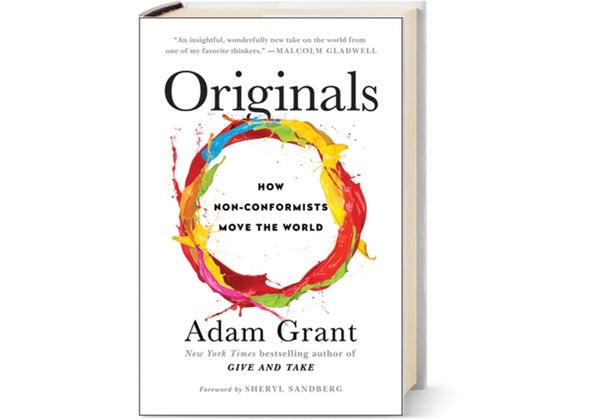
Originals: How Non-Conformists Move the World
by Adam Grant
Viking, 2016 ($27; 336 pages)
When economist Michael Housman wanted to understand why some customer service agents performed better than others, he considered scores of variables and found one in particular that distinguished those with happier customers and higher sales: the browser they used. Agents using Firefox and Chrome consistently outperformed agents using Internet Explorer on a number of measures—but not for reasons that had anything to do with the browsers themselves.
Housman concluded that agents on Internet Explorer, the default browser in the Windows operating system, were approaching their work as they approached their software, relying on built-in scripts and routines. In contrast, the Firefox and Chrome users, who had taken the time to download their browsers, were also showing more initiative on the job.
On supporting science journalism
If you're enjoying this article, consider supporting our award-winning journalism by subscribing. By purchasing a subscription you are helping to ensure the future of impactful stories about the discoveries and ideas shaping our world today.
Browsers aside, the fact is that most of us don't always take that extra step. “We live in an Internet Explorer world,” explains University of Pennsylvania's Wharton School professor Grant in his new book. But true originals do take that step, he says. Grant draws on his own research conducted in tech companies, banks and governments to showcase what leads to success. To be original, he notes, a person cannot simply have a new idea but must also act on that vision. For many of us, going the extra mile seems out of our reach. We think Steve Jobs, Jerry Seinfeld, Jackie Robinson and their ilk are simply cut from a different cloth. But Grant argues, “Originals are actually far more ordinary than we realize.”
After studying these nonconformists in depth, he discovered that “their inner experiences are not any different from our own. They feel the same fear, the same doubt, as the rest of us.” Yet they take action anyway. Grant shares their wisdom, providing insights on how they nurture creativity, overcome the fear that often holds us back and distinguish good ideas from bad ones.
Got the jitters? Reframe fear as excitement, Grant says: “Rather than trying to suppress a strong emotion, it's easier to convert it into a different emotion—one that's equally intense, but propels us to step on the gas.” Feel like you are procrastinating and wasting time? Instead of quitting or getting discouraged, use these delays—as innovators tend to do—as incubation periods to separate the half-baked ideas from the winners. Martin Luther King, Jr., may have waited until the night before the March on Washington to finalize his “I Have a Dream” speech, for example, but he spent the weeks before reviewing ideas and approaches with close advisers.
Grant tackles complex ideas at a fast, sometimes frenetic pace, which can feel overwhelming. But overall, his engaging style and sharp insights make for a compelling read. His best advice for would-be game changers? Be curious. “When we become curious about the dissatisfying defaults in our world, we begin to recognize that most of them have social origins: Rules and systems were created by people,” he writes. “And that awareness gives us the courage to contemplate how we can change them.”