
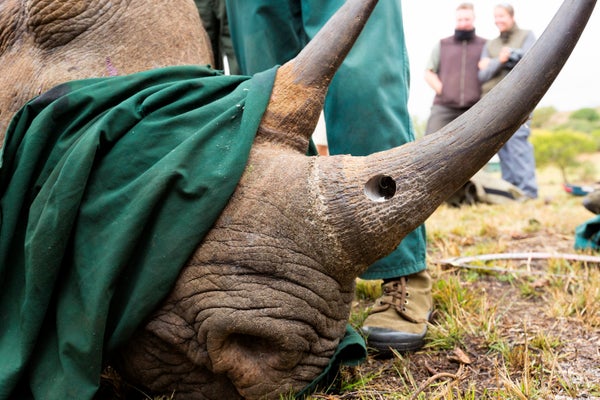
A genetic database that holds DNA from thousands of African rhinoceroses has secured the convictions of poachers and led to stiffer criminal sentences since its establishment eight years ago, researchers say. However, not all scientists are convinced the effort is worthwhile.
In an 8 January paper in Current Biology, researchers highlight the database, which has been used in more than 120 cases. In one example, rhino poacher Simon Ngomane was sentenced to 28 years in prison last year, following a 2011 shootout with rangers in South Africa’s Kruger National Park. He was convicted, in part, because of DNA evidence that linked two freshly cut horns to an animal that had just been slaughtered in the park.
“The majority of cases in which we have been able to make these individual links have led to convictions and, in many cases, significant sentences,” says Cindy Harper, a veterinary geneticist at the University of Pretoria in South Africa who began developing the database in 2010 to provide evidence that could be used in legal proceedings.
On supporting science journalism
If you're enjoying this article, consider supporting our award-winning journalism by subscribing. By purchasing a subscription you are helping to ensure the future of impactful stories about the discoveries and ideas shaping our world today.
Rhino poaching has risen sharply in South Africa since the mid-2000s, with more than 1,000 individuals killed in each year between 2013 and 2016. Their keratin-rich horns can sell for more than US$60,000 per kilogram. “That’s like gold cocaine,” says Samuel Wasser, a conservation biologist at the University of Washington in Seattle.
So far, samples from more than 5,800 rhino crimes have been submitted to the database, resulting in more than 120 criminal cases, says Harper. Although it is difficult to make any causal link between the existence of the database and trends in poaching, Rod Potter, a wildlife investigator at conservation agency Ezemvelo KZN Wildlife in Pietermaritzburg, South Africa, says that poachers who have been convicted using DNA evidence are less likely to appeal against their sentences.
Bang for the buck?
Not everyone is sold on the value of a rhino database. Wasser points out that just 2% of crimes have resulted in a criminal case. “It’s not giving you the bang for the buck,” says Wasser, whose team has identified elephant poaching hotspots using DNA from seized ivory, in the hope of stemming the trade at its source. “You need to go backwards and get as much information from seizures as you can, so you can predict where the next events are going to take place,” he says.
But Harper and her team say that the database is leading to information that can help destroy poaching syndicates, many of which are based in Asia. A horn recovered in Singapore, for example, was linked through DNA to a carcass that had been found six weeks earlier. A poacher bound for Hong Kong who was arrested at a checkpoint in Swaziland helped to identify a new trafficking route on the basis of DNA links from three horns that were seized and matched to crime sites.
The biggest challenge to breaking up syndicates, Potter says, is convincing police forces in foreign countries to pursue poachers with the same zeal he now sees in South Africa. “The DNA is showing us all sort of interesting things, but you’ve got to get the police departments to investigate further.”
This article is reproduced with permission and was first published on January 8, 2017.