
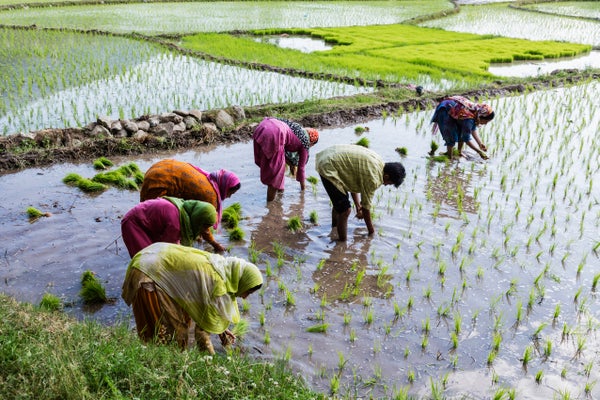
Rice, wheat and other grains that have been bred to produce larger harvests using less land have been critical to feeding Earth’s population in the past 50 years. But these crops come with a significant cost: Their thirst for the chemical nutrients in fertilizer contributes to pollution that threatens air, land and sea. Now a team of scientists have genetically engineered new high-yield grain varieties that require less fertilizer and thereby could prove more environmentally friendly.
The green revolution of the 1950s and '60s supercharged agricultural production worldwide, thanks to breeding innovations, added fertilizer and other management technologies. Crop yields boomed, nourishing millions. “In that time people just wanted food security,” says Xiangdong Fu, a plant geneticist at the Chinese Academy of Sciences. But it soon became clear the heavy use of nitrogen fertilizer wreaks havoc on ecosystems. Excess nitrogen can degrade air quality and trigger harmful algal blooms in water, often with deadly consequences for fish and other wildlife. As the human population and its need for food has continued to climb, scientists have sought ways to optimize fertilizer use without sacrificing crop yields.
Fu and his team think they’ve found the key in grains’ genes. Their survey of the DNA of 36 rice varieties revealed a gene encoding growth-regulating factor 4 (GRF4), a protein that enhanced both nitrogen uptake and growth. But the nitrogen-hungry crops also owe their efficiency to a family of growth-suppressing proteins called DELLA, which yield more diminutive plants that can better withstand strong weather. Using genetic engineering, the team tipped the GRF4–DELLA balance by increasing expression of the GRF4-producing gene, the authors wrote Wednesday in Nature. The researchers found similar results for wheat. The new crops look like a win–win: more efficient consumers of fertilizer that are squat enough to stay upright in wind and rain.
On supporting science journalism
If you're enjoying this article, consider supporting our award-winning journalism by subscribing. By purchasing a subscription you are helping to ensure the future of impactful stories about the discoveries and ideas shaping our world today.
A campaign to mix a desired trait such as nitrogen efficiency into rice varieties could be carried out efficiently and quickly, says Alan Bennett, a crop geneticist at the University of California, Davis, who was not involved in the study. Labs around the world could rely on conventional breeding or gene-editing techniques to introduce the GRF4-producing gene into locally adapted varieties. This sort of human-aided trait transmission is common, Bennett says. For example, rice developed to tolerate prolonged flooding in the Philippines was later bred into local rice varieties in India and Bangladesh.
Experts welcome the promise of more nitrogen-efficient grains. “Human activity is adding too much nitrogen to the planet,” says Xin Zhang, an environmental scientist who studies the global nitrogen cycle at the University of Maryland Center for Environmental Science and did not take part in the research. She notes humans have doubled the amount of excess nitrogen in the environment since the start of the industrial era, largely due to fertilizer that leaks off farm fields. “It’s critical to improve the efficiency of the system,” she says.
Genetic engineering alone, however, cannot solve the “wicked problem” of nitrogen pollution, Zhang adds. The behavior of the farmers also matters. She says farmers often choose how much nitrogen to add to fields based on socioeconomic factors such as fertilizer cost, regardless of what crops need. Nathan Mueller, an agricultural systems researcher at the University of California, Irvine, who was also not part of the work, sounded a similar note. If farmers used more precise methods to “apply the right amount of nitrogen at the right time in the right location,” he says, that also could mitigate nitrogen runoff.
Zhang says curbing fertilizer use will require a coordinated approach between crop geneticists, economists and ecologists. Fertilizer-friendly crops, then, would be just one more tool—and a welcome one—for controlling pollution caused by agriculture.