
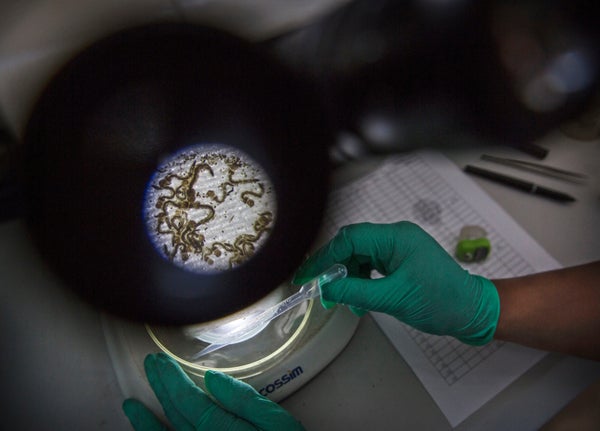
Two major philanthropic organizations, along with the United States and Britain, announced on Wednesday an ambitious experiment to combat mosquito-borne diseases in cities by infecting the insects with crafty bacteria.
Researchers have used the bacteria, known as Wolbachia, in trials in places including Australia and Brazil in recent years. But those efforts were small, reaching areas with tens of thousands of residents.
The new trials will cover urban areas with millions of people. The goal: to see if the promising results from the early field trials can be replicated, and, possibly, to demonstrate that the approach can halt viruses like Zika and yellow fever.
On supporting science journalism
If you're enjoying this article, consider supporting our award-winning journalism by subscribing. By purchasing a subscription you are helping to ensure the future of impactful stories about the discoveries and ideas shaping our world today.
“This is an order of magnitude bigger than anything that’s been attempted before,” said Mike Turner, acting director of science at the Wellcome Trust, one of the groups funding the effort. “That’s the question—can you do it to scale?”
The US and UK governments and the Gates Foundation are also contributing to the $18 million campaign. The group running the trials, the Eliminate Dengue Program, will be testing how loading Aedes aegypti mosquitoes with the Wolbachia bacteria affects cases of Zika, dengue, and chikungunya in cities in Brazil and Colombia over two to three years.
Wolbachia bacteria are found naturally in many insects, but not Aedes aegypti. When the bacteria are introduced to these mosquitoes, they take up residence in the insects’ cells, preventing viruses from multiplying and from being passed to people the insects bite. When mosquitoes with Wolbachia are released into the wild and breed, their offspring are born with the bacteria and can’t spread disease either.
Eliminate Dengue has run trials in Colombia, Brazil, Vietnam, Indonesia, and Australia over the past five years. The new trials will ramp up those efforts in Colombia and Brazil, the two countries hardest hit by the recent Zika outbreak.
In Colombia, the trial will take place in the city of Bello, and in Brazil, it will cover parts of the greater Rio de Janeiro area. Because lots of people and lots of mosquitoes live so densely in cities, urban areas are more vulnerable to mosquito-borne diseases than rural areas. Aedes aegypti only fly a few hundred yards in their lifetimes.
Making resistant mosquitoes
The effort’s expansion comes as companies and public agencies explore more ways of controlling mosquito-borne diseases by using mosquitoes themselves.
A Kentucky-based company, MosquitoMate, uses another Wolbachia strain to a different end than Eliminate Dengue: to prevent mosquitoes from reproducing. The company infects male mosquitoes (which don’t bite—that’s only the females) with a kind of Wolbachia and releases them into the wild. When they mate with wild females, their offspring don’t hatch.
MosquitoMate’s first trials focused on Aedes albopictus, another mosquito species that can spread diseases to people. (It can transmit Zika, although not as efficiently as Aedes aegypti). But it has also started trials targeting Aedes aegypti; mosquito control officials in the Florida Keys last week approved a trial with MosquitoMate mosquitoes starting in March.
Alphabet—formerly Google—has also entered the mosquito game. Verily, its life sciences arm, this month announced the Debug project, which aims to make the process of breeding Wolbachia-carrying mosquitoes and separating and releasing the males more efficient. Its initial target is Aedes aegypti; the company hasn’t said yet where it intends to conduct its first field trials.
Efforts to use Wolbachia to reduce mosquito populations require ongoing releases of male mosquitoes as the ones that have been released die out. But Eliminate Dengue said releasing both female and male mosquitoes with its strain of Wolbachia over a few weeks is all that’s needed for its plan. After a few generations, enough mosquitoes are carrying the bacteria that the cycle of disease transmission stops.
Infecting mosquitoes with Wolbachia is just one approach. A company called Oxitec genetically modifies mosquitoes so that when they mate with wild mosquitoes, their offspring die before they can mature and breed. It has run trials in places including Panama and Brazil and has seen both mosquito populations and, in some cases, dengue transmission fall by 90 percent in a matter of months.
The company has proposed a field trial in the Florida Keys, to which the Food and Drug Administration gave the green light in August. Residents are voting on the trial in a nonbinding referendum next month, and the final approval rests with the Florida Keys Mosquito Control District.
Some residents have protested the plan to release genetically modified mosquitoes in the Keys, but fewer concerns are typically raised about the Wolbachia mosquitoes. The bacterial approach also has had an easier regulatory route in the US: The mosquitoes are considered “biopesticides” by the Environmental Protection Agency and don’t need FDA approval to be released, unlike the Oxitec mosquitoes.
Republished with permission from STAT. This article originally appeared on October 21, 2016