
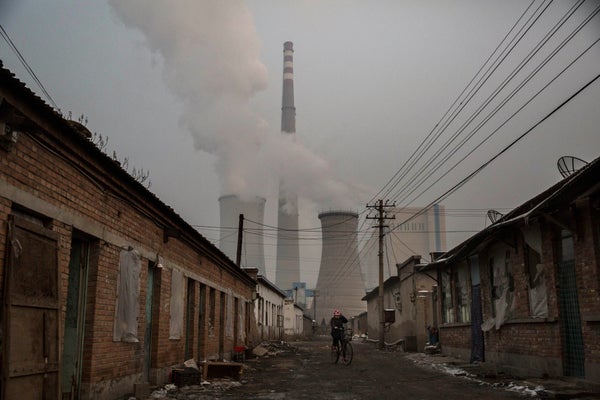
For anxious climate hawks fretting over the expected rollback of environmental regulations from the Donald Trump presidency, here is a small spot of good news: Global carbon emissions from the burning of fossil fuel did not grow at all last year.
What’s more, the carbon dioxide emissions that cause the Earth to warm may have plateaued even as the United States enters an era with a president promising to rejuvenate its depleted coal industry, experts said.
The significant slowdown in emissions is part of a three-year trend, according to a study published Monday in the journal Earth System Science Data. Emissions are expected to rise slightly this year, by 0.2 percent. In 2013, they grew just 0.7 percent. That’s a sharp drop from the 2.3 percent annually they grew from 2003 to 2013.
On supporting science journalism
If you're enjoying this article, consider supporting our award-winning journalism by subscribing. By purchasing a subscription you are helping to ensure the future of impactful stories about the discoveries and ideas shaping our world today.
China’s decreasing use of coal was the primary reason for the drop, said Corinne Le Quéré, a University of East Anglia professor and primary author of the study. And while Americans used more oil and gas in 2015, the United States decreased emissions by 2.6 percent as the use of coal declined. Researchers expect to see a decrease in emissions of 1.7 percent in 2016.
The dip is particularly significant because China is the world’s largest carbon emitter, accounting for about 30 percent of the world’s annual global emissions, she said. The country is taking steps to address the quality of the coal it uses and increase air pollution controls.
“All of a sudden, it looks like it might be possible that the global emissions decrease and we can start to have a real a handle on dealing with climate change,” Le Quéré said.
Still, it’s unclear exactly how much of the decline can be attributed to China’s economic troubles and how much to environmental efforts.
Even if China’s reduction in coal usage is due to economic troubles, such as a decline in its housing market and manufacturing, it provides a new benchmark the country can maintain as it ramps up its economy, said Glen Peters, a senior researcher at the Center for International Climate and Environmental Research in Norway.
“You can be cautiously optimistic, but it’s probably only due to China and economic conditions, largely,” he said. “However, since those changes have happened, it’s also an opportunity to lock those changes in if you like and move forward from there. It’s an opportunity if you’d like to avoid emissions going up again.”
‘I don’t want to get too enthusiastic’
Most notably, the reduction comes during a period of worldwide economic growth, she said. Le Quéré said it’s “unprecedented” to see such a drop in recent years, since there has been a growing amount of emissions since the oil crisis of the 1970s.
The United States saw a significant drop in emissions, largely as the power industry shifts away from coal to natural gas. Emissions dropped 2.6 percent last year and are projected to drop 1.7 percent this year.
But the way the United States—the world’s second-largest emitter of carbon, accounting for 15 percent of the total—handles its emissions the next four years is essential if the warming of the earth is to be slowed.
The study was released to coincide with the U.N. climate talks in Morocco, where world leaders are looking to push even further on the Paris Agreement among about 200 nations to reduce emissions. Trump has pledged to pull out of the accord, shrouding its effectiveness in uncertainty.
So even though the reductions in emissions are truly good news, the future is more bleak, said Michael Oppenheimer, a professor of geosciences and international affairs at Princeton University.
“We have one country that happens to be the second-biggest emitter and happens to be the most important country geopolitically, in terms of the ability to provide leadership, and that country may be on the verge of stepping back,” he said. “I don’t want to get too enthusiastic about a trend that we don’t even know if it’s a long-term trend, and I certainly don’t want to predict exactly what Trump will do.”
Reprinted from ClimateWire with permission from E&E News. E&E provides daily coverage of essential energy and environmental news atwww.eenews.net.
