
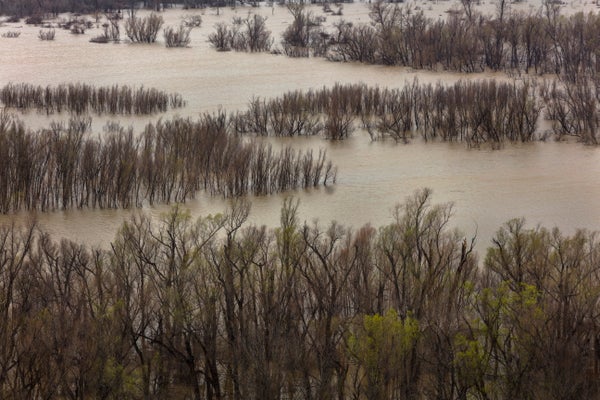
Increased precipitation resulting partially from climate change has caused an additional $2.5 billion a year in U.S. flood damage, according to a new study that pinpoints the effect of changing weather on the cost of natural disasters.
A study published yesterday in the Proceedings of the National Academy of Sciences journal says that from 1988 through 2017, intensifying precipitation was responsible for a total of $75 billion in U.S. flood damage over the 29-year study period. Total flood damage in those years was nearly $200 billion, meaning that the excess precipitation accounted for more than a third of the damage in that period.
“The fact that a third of the total [flood damage] is contributed by increasing precipitation is substantial,” said study co-author Noah Diffenbaugh, a climate scientist at Stanford University.
On supporting science journalism
If you're enjoying this article, consider supporting our award-winning journalism by subscribing. By purchasing a subscription you are helping to ensure the future of impactful stories about the discoveries and ideas shaping our world today.
The study analyzes only precipitation-related flooding, which includes most riverine flooding, and excludes coastal flooding, which is often caused by storm surge.
The study aims to answer a major question about the increasing cost of natural disasters in an era of global warming—how much of the growing damage is caused by climate or weather patterns, and how much is caused by the nation’s increasing wealth and growing development in hazard-prone areas such as flood zones.
NOAA said last week in a blog post about increasing disaster costs that the nation’s growing population and wealth “are an important cause for the rising costs” and that “climate change is also playing a role.”
The new Stanford study focuses on the effects of increasing precipitation on flood damage. It does not directly link the increased flood damage to climate change. Instead, the study notes climate models show that human-induced climate change increases the probability of the type of extreme precipitation events that account for most U.S. flood damage.
“Climate change may be exacerbating the cost of flooding,” the study says.
The precipitation-related increases in flood damage from 1988 through 2017 “cannot be entirely attributed to anthropogenic climate change,” the study says, adding that the damage increases “represent the combined effects of anthropogenic forcing and natural variability.”
“Future global warming is very likely to increase the costs of flooding,” the study says, adding that “damages from flooding could be greatly reduced under a low-emissions scenario consistent with the UN Paris Agreement.”
“The higher the level of global warming in the future, the greater the intensification of those extreme precipitation events,” Diffenbaugh said.
The study could bolster efforts by President-elect Joe Biden to adopt strategies aimed at reducing U.S. and global emissions of greenhouse gases. Biden has pledged to rejoin the Paris climate agreement and to invest up to $2 trillion in infrastructure and jobs that support cleaner energy and transportation.
“This shows that there is real economic value in avoiding higher levels of global warming,” Diffenbaugh said. “That’s not a political statement. That’s a factual statement about costs. And it also shows that there’s real economic value to adaptation and resilience because we’re clearly not adapted to the climate change that’s already happened.”
Flooding is one of the most damaging types of natural disasters. NOAA’s recent analysis of major disasters since 1980 found that hurricanes accounted for $1 trillion of the $1.9 trillion in damage from the nation’s costliest disasters. Inland flooding accounted for $150 billion in damage during major disasters, which are those that cause at least $1 billion in damage, NOAA found.
Reprinted from E&E News with permission from POLITICO, LLC. Copyright 2021. E&E News provides essential news for energy and environment professionals.