
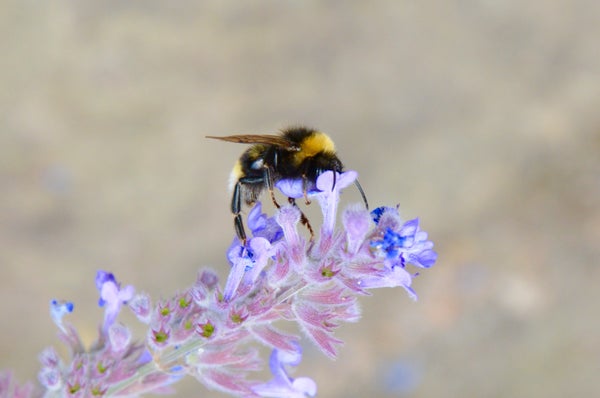
What would spring be without the gentle drone of fuzzy bumblebees, lazily dipping in and out of flowers in the warm sunshine? Unfortunately, research suggests, much of the country may be at risk of finding out. And climate change is at least partly to blame.
Bumblebee populations have plunged in both Europe and North America over the last few decades, a new study suggests. The likelihood that a given location is populated by bumbles has dropped by a whopping 46% in North America, compared with what it was prior to the 1970s. And it’s fallen by about 17% in Europe.
That’s likely due to a number of factors, including land use changes, habitat loss and pesticide use. But rising temperatures have also likely played a significant role, the research suggests.
On supporting science journalism
If you're enjoying this article, consider supporting our award-winning journalism by subscribing. By purchasing a subscription you are helping to ensure the future of impactful stories about the discoveries and ideas shaping our world today.
The new study, conducted by researchers from Canada’s University of Ottawa and the United Kingdom’s University College London, found that bee declines tended to be linked to higher temperatures. The study was based on observations of 66 species across both continents.
Bees don’t function well once the temperature reaches a certain point, said lead study author Peter Soroye of the University of Ottawa.
“We know that when temperatures start to get really hot, bees start to have a lot of difficulty flying and foraging,” he told E&E News.
Additionally, rising temperatures can also affect the vegetation that bees depend on for survival.
The researchers note that different bee species have different temperature limits. And in some cases, a warmer climate can open up new areas for bumblebees to move into. But that’s only true up to a certain point—eventually, it’s likely to become too warm.
Overall, the study finds that warming is a lot less likely to be associated with population increases than decreases.
“The local extinction events we found—so, the disappearances of bees from regions—were happening about eight times more than these reestablishment events,” Soroye said. “So bees are just not able to keep pace with the threat of climate change and everything else.”
The impacts seem to be strongest in places with warmer climates to begin with. Cooler areas were more likely than warmer ones to see bees moving in, rather than moving out. But declines were still evident across all areas, even those with milder climates.
It’s not the first study to suggest a link between climate and bee declines. One of the new study’s authors, Jeremy Kerr of the University of Ottawa, previously led a study suggesting that climate change was causing suitable bee habitat to shrink in both North America and Europe.
There’s been less research on bumbles and climate in other parts of the world, although they’re widespread across much of Asia and in parts of the Southern Hemisphere, as well. But at least one recent modeling study has suggested that East Asian bee species may also decline with continued climate change.
The authors of the study are careful to note that climate change isn’t the only factor at play. Human land use changes, the expansion of agriculture, habitat losses and pesticide use are all thought to be top contributors to bee declines.
In some ways, these issues may feel easier to address with local solutions—like planting more bee habitats and avoiding certain chemicals—than the looming problem of climate change, which must ultimately be addressed by reducing greenhouse gas emissions on a planetary scale. But there are still some actions that local communities can take to protect bees from rising temperatures, Soroye suggests.
Bees need to take breaks and shelter in cool places when it gets too hot. So providing shady habitat for them, like trees or hedges, could make a small difference.
And he added that, despite its grim statistics, the research allows some room for optimism, as well.
“At the end of the day, we’re developing theories and tools and techniques that work really well to predict the extinction of bumblebees—and hopefully we can apply them to other groups, as well: birds and amphibians and reptiles,” Soroye said. “If we have a better idea of why climate change is driving extinction, we can have a better idea of how to stop it.”
Reprinted from Climatewire with permission from E&E News. E&E provides daily coverage of essential energy and environmental news at www.eenews.net.
