
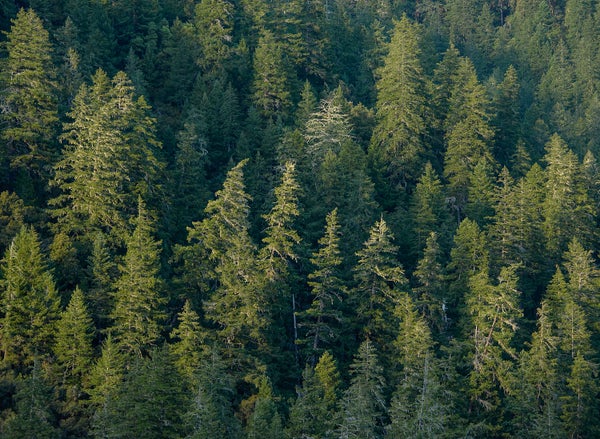
Just as the planet is being taxed from record-breaking temperatures, new research finds iconic Douglas firs across the West are water- and heat-stressed.
Similar to the humans who find themselves sluggish during a heat wave, when water is scarce, Douglas firs also put the brakes on growing — a choice that could have ramifications for forest carbon stocks and the global carbon cycle.
“If trees are being less productive, if they are not growing as well, they are taking in less CO2 from the atmosphere,” said Christina Restaino, a postdoctoral researcher at the University of California, Davis. “Tree stress can lead to the point where trees die, and when we lose tree species on the landscape, there’s always the question of what is going to grow back in its place.”
On supporting science journalism
If you're enjoying this article, consider supporting our award-winning journalism by subscribing. By purchasing a subscription you are helping to ensure the future of impactful stories about the discoveries and ideas shaping our world today.
Restaino led research that examined data from more than 2,000 tree cores from 122 locations across the Western United States. The study, published this week in the journal Proceedings of the National Academy of Sciences, found increasing temperatures hurt tree growth.
That’s because rising temperatures remove water from both the soil and atmosphere, causing the Douglas firs to lose water faster than they can take it in.
As a result, the stressed trees close their stomata, or the tiny pores that take in carbon dioxide during photosynthesis and release oxygen as a byproduct.
Using climate models to project into the future, the team found the amount of time increased temperatures are expected to strip the air of moisture could up to double by the 2080s. Similar declines in tree growth are then expected, the study found.
The effects were most pronounced in the Southwest, which is already experiencing higher temperatures. Douglas firs in the Pacific Northwest fared a bit better.
“This is a species that has been logged historically and still is, so it certainly is important in terms of thinking about not only how our ecosystems are responding to changes in climate, but also in changes of the economics of forest management, as well,” Restaino said.
Instead of tapping into an extensive and well-regarded tree core data set, the International Tree-Ring Data Bank (ITRDB), as done with many other studies, Restaino and her co-authors spent three summers coring trees themselves. The researchers also used tree ring data collected by co-author Jeremy Littell, lead research scientist with the U.S. Geological Survey at Alaska’s Climate Science Center.
By collecting the cores, Restaino said they were able to get a snapshot of how Douglas firs have responded to climate signals across the species’ entire U.S. range between 1916 and 2006. In addition, ITRDB cores are often taken from trees located in the harshest environments so they can be easily connected to the climates of past years, but that means they represent the top of the species’ response to climate changes.
“We can tell a larger story about a whole range of tree-growing environments,” she said.
Researcher David Peterson, with the Forest Service’s Pacific Northwest Research Station, was also a co-author.
Reprinted from ClimateWire with permission from Environment & Energy Publishing, LLC. E&E provides daily coverage of essential energy and environmental news at www.eenews.net. Click here for the original story.
