
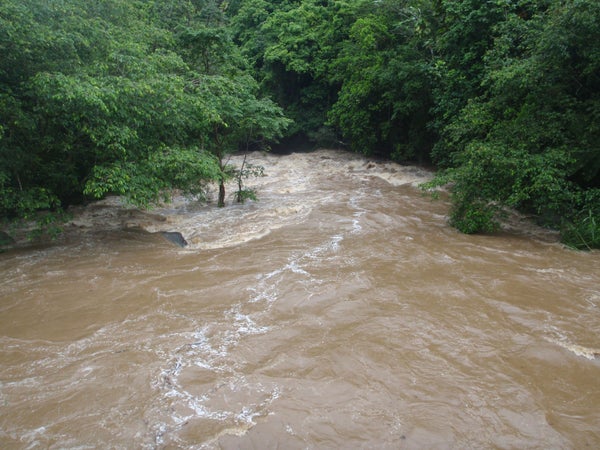
Large storms with lots of rain, which are prominent in future climate predictions, have the potential to flood rivers and change the landscape. But gravelly rivers coming from the mountains have the ability to resist large, fast floods without permanently changing their banks and altering their courses, according to a new study of more than 186 rivers.
“What we discovered was that rivers have this ability to self-regulate,” says Douglas Jerolmack, a geophysicist at the University of Pennsylvania and an author of the report, published today in Science. Essentially, big floods cause rivers to quickly deepen and widen channels, reducing the force of the water rushing through. Less force means floods lose their ability to erode river banks, and the rivers gradually return to normal. “This effect blunts the impact of extreme rains on the landscape,” he says.
“Big floods can still have a devastating effect on the landscape surrounding a river,” cautions Taylor Perron, a geologist at the Massachusetts Institute of Technology who specializes in erosion and landscape evolution. He agrees the new research explains why gravelly streams can withstand high water flow, “but not sandy or silty rivers, where typical flows are much stronger” and move lots of sediment before the water force drops back down.
On supporting science journalism
If you're enjoying this article, consider supporting our award-winning journalism by subscribing. By purchasing a subscription you are helping to ensure the future of impactful stories about the discoveries and ideas shaping our world today.
“Yes, I don’t want people picturing wide, sandy rivers like the Mississippi when they think about this process,” Jerolmack says. “That’s not what we are talking about. Instead, think about the headwaters of rivers that start in mountains, coarse-sediment streams that eventually become broader rivers like the Hudson or the Delaware.”
The beds of these watercourses are filled with gravel and cobblestones. Jerolmack and his co-author, Colin Phillips of the University of Minnesota, placed radio-tracking tags on stones in a river prone to flash floods. They found that the heaviest rainstorms increased the water volume coming out of the river 100 times more than normal. But the large amount of water barely moved the stones, only shoving them around as far as a typical run-of-the-mill rain shower.
The geologist then gathered data from the U.S. Geological Survey on many other rivers, tracking the velocity of flow and the sediment size. In the gravel-filled river, flows that exceeded the force needed to lift up and move the stones were very rare.
These rivers have ways of fine-tuning themselves, Jerolmack says. They can overflow their banks and deepen their channels when a lot of water comes down. That makes the overall channel bigger, which reduces the velocity of the water. And that force drops back down to normal before it can permanently alter the banks. “What I predict is that with climate change and these rivers, initially there will be more flooding,” Jerolmack says. “Then the river will drop its depth and eventually there will be no unusual floods.”
This effect does have limits, particularly on rivers where people have built up the sides and channeled the beds to keep the water in its course. Paradoxically, Jerolmack says, that takes away a river’s own ability to adjust. So the water velocity will stay high and floods will do more damage. And waterways such as the Mississippi and the Missouri have smaller, lighter sediments which can be moved around much more easily. “That is where the biggest floods typically happen,” says Perron. “The authors are not saying the human landscape is protected from climate extremes.”