August 20, 2008
1 min read
 Add Us On GoogleAdd SciAm
Rivers of Stars Found in Milky Way
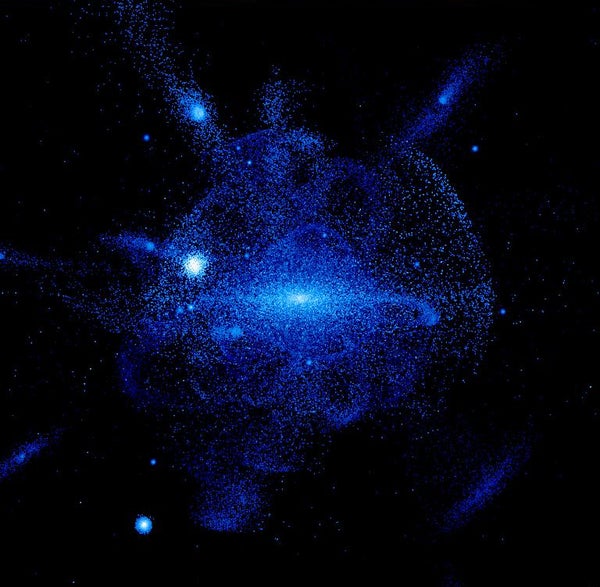
Astronomers have discovered nearly a dozen new stellar rivers —strings of moving stars—over the disk of the Milky Way.
On supporting science journalism
If you're enjoying this article, consider supporting our award-winning journalism by subscribing. By purchasing a subscription you are helping to ensure the future of impactful stories about the discoveries and ideas shaping our world today.
Astronomers have discovered nearly a dozen new stellar rivers—strings of moving stars—over the disk of the Milky Way. The streams, which seem to represent smaller galaxies torn apart by our own, come from scans of the velocities of about a quarter million stars in our galaxy made for the Sloan Digital Sky Survey. Prior scans had turned up a few narrow rivers such as one extending from the star cluster NGC 5466, 76,000 light-years away, that covers 45 degrees across the northern sky. The 11 new entries form a tangle that's harder to separate. Researchers believe that the streams arose separately when neighboring star clusters known as dwarf galaxies were drawn apart like taffy by the Milky Way's larger gravitational field. They say the new findings, reported at a conference this week, could be used to improve models of galaxies colliding with and cannibalizing one another.
It’s Time to Stand Up for Science
If you enjoyed this article, I’d like to ask for your support. Scientific American has served as an advocate for science and industry for 180 years, and right now may be the most critical moment in that two-century history.
SciAm always educates and delights me, and inspires a sense of awe for our vast, beautiful universe. I hope it does that for you, too.
If you subscribe to Scientific American, you help ensure that our coverage is centered on meaningful research and discovery; that we have the resources to report on the decisions that threaten labs across the U.S.; and that we support both budding and working scientists at a time when the value of science itself too often goes unrecognized.
In return, you get essential news, captivating podcasts, brilliant infographics, can't-miss newsletters, must-watch videos, challenging games, and the science world's best writing and reporting. You can even gift someone a subscription.
There has never been a more important time for us to stand up and show why science matters. I hope you’ll support us in that mission.