August 31, 2012
1 min read
 Add Us On GoogleAdd SciAm
Road Trip!: Curiosity Gets Gritty as it Embarks on Its Journey
Twenty-two days after dropping in on the Red Planet, Curiosity continued to prep for its most excellent adventure.
On supporting science journalism
If you're enjoying this article, consider supporting our award-winning journalism by subscribing. By purchasing a subscription you are helping to ensure the future of impactful stories about the discoveries and ideas shaping our world today.
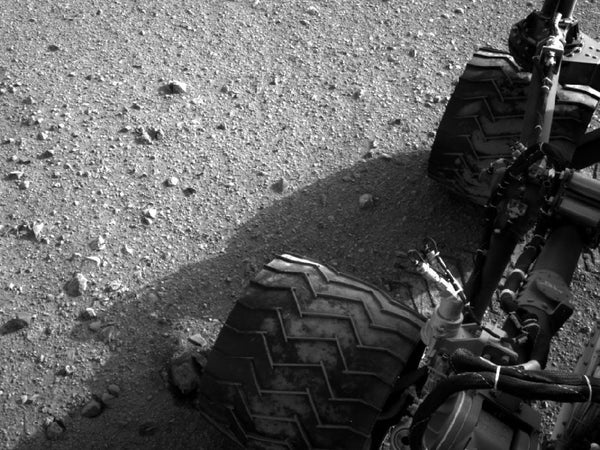
Twenty-two days after dropping in on the Red Planet, Curiosity continued to prep for its most excellent adventure. The plutonium-powered mobile lab took its longest spin yet on Tuesday. Its third drive was more than a test, however, moving the rover eastward about 16 meters on the first leg of its weeks-long trip to its first destination, a site called Glenelg. Here Curiosity will find three types of terrain and a locale ripe with rocks for analysis. This image, taken by the rover's navigation camera, shows soil gathered from its recent foray caked on its right middle and rear wheels.
Before the mobile lab reaches Glenelg, project scientists plan to make more pit stops than a vacationing family who drank too many Big Gulps. These pauses will be used to test rover systems and gather data. During the next layover scientists will test Curiosity's robotic arm and its instrumentation. At Tuesday's stop, the Mast Camera gathered images of the rover's ultimate destination, 5.5-kilometer Mount Sharp's lower slope.
—Michael J. Battaglia
It’s Time to Stand Up for Science
If you enjoyed this article, I’d like to ask for your support. Scientific American has served as an advocate for science and industry for 180 years, and right now may be the most critical moment in that two-century history.
SciAm always educates and delights me, and inspires a sense of awe for our vast, beautiful universe. I hope it does that for you, too.
If you subscribe to Scientific American, you help ensure that our coverage is centered on meaningful research and discovery; that we have the resources to report on the decisions that threaten labs across the U.S.; and that we support both budding and working scientists at a time when the value of science itself too often goes unrecognized.
In return, you get essential news, captivating podcasts, brilliant infographics, can't-miss newsletters, must-watch videos, challenging games, and the science world's best writing and reporting. You can even gift someone a subscription.
There has never been a more important time for us to stand up and show why science matters. I hope you’ll support us in that mission.