
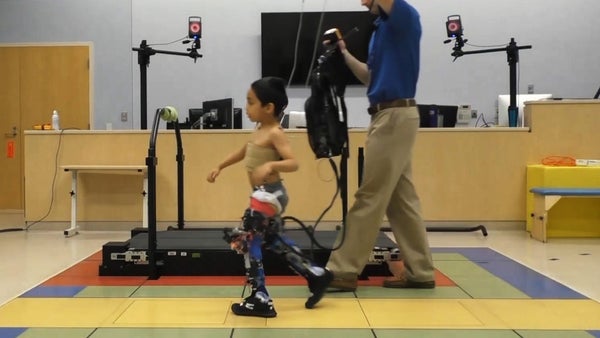
In the first clip, the boy appears to drag his feet as he walks, while his knees—particularly the left one—stay bent throughout his steps.
In the second clip, his knees remain bowed inward. But his legs—now clad in a robotic exoskeleton—swing more as they move, and his feet lift off the ground and his knees bend and flex in time with his step.
The boy is one of seven children with cerebral palsy who were outfitted with exoskeletons in hopes that the robotic devices could improve their crouched posture, making it easier for them to take simple steps. Those steps will otherwise become more difficult over time; 50 percent of people with cerebral palsy stop walking when they reach adulthood.
On supporting science journalism
If you're enjoying this article, consider supporting our award-winning journalism by subscribing. By purchasing a subscription you are helping to ensure the future of impactful stories about the discoveries and ideas shaping our world today.
In a study published Wednesday in the journal Science Translational Medicine, researchers reported that the exoskeletons helped most participants straighten their legs as they walked, alleviating the permanent knee bend that causes the crouching disorder known as “crouch gait.” The researchers also found that while the exoskeletons provided support when it was needed, participants were still in control of their own steps.
A test of the NIH pediatric exoskeleton, which was built to provide walking assistance to children with cerebral palsy. Credit: Functional & Applied Biomechanics Section, Rehabilitation Medicine Department, NIH Clinical Center
The study was an initial attempt to show that exoskeleton technology should be explored further as a tool to help children with cerebral palsy maintain mobility, said Thomas Bulea, a biomedical engineer at the National Institutes of Health and one of the paper’s authors. Now, researchers want to determine whether long-term use of the exoskeleton, including outside of a research setting, could ease crouch gait even when the exoskeleton isn’t being worn. The hope is that such extensive training could enable people with cerebral palsy to walk on their own for much longer.
“We want to transfer the walking patterns we see with the exoskeleton to walking without the exoskeleton,” Bulea said. “If we can correct or treat this crouch gait at a young age, then throughout their life, we may be able to increase their mobility.”
Cerebral palsy is a neurological condition that leads to problems with movement and coordination. With crouch gait, children can often walk on their own, adapting to taking steps in a crouched position. It’s often treated with therapy, surgery, or injections that relax the knee flexors. But still, as people get older and get bigger, it becomes harder to walk.
The new research is a long way from showing that exoskeletons would be an effective clinical solution, and many outstanding questions remain.
For the study, researchers only recruited children who were still able to walk well independently. They want to investigate whether an exoskeleton could help children who have already lost more mobility, as well as with children with other conditions that lead to mobility problems, such as spina bifida or muscular dystrophy.
“It may be useful for some of those kids, but more severe kids may not benefit,” said Dr. Bruce Dobkin, the director of the UCLA Neurological Rehabilitation and Research Program, who was not involved with the study.
Moreover, there is the concern that exoskeletons may not help preserve mobility as children age. That has also been the case with some surgeries and medications, Dobkin said. In those cases, the interventions may not be worth the effort or cost, in part because children have an “amazing ability to compensate” and walk with gait problems while they are still ambulatory, he said.
Still, those are concerns that a longer and larger study could help answer. In this study, six of the seven participants saw improvements in their crouch gait and knee extension, gaining an average of about 13 degrees in knee angle as they stepped. The children also saw improvements over the course of their training sessions, which Bulea said suggests that further gains may be possible with additional exoskeleton use.
The researchers hope that they can refine the exoskeletons so they can be worn outside the lab. That could provide the amount of training necessary to extend benefits even when the device isn’t being worn.
The study is one of the first attempts to bring exoskeleton technology to children and adolescents. So far, exoskeleton trials have largely been aimed at restoring movement in adults who were paralyzed after a stroke or spinal injury, including the exoskeleton-wearing man who kicked a soccer ball at the start of the 2014 World Cup.
In those cases, patients needed the exoskeleton to restore lost movement. But in the new study, the exoskeletons were being used in an attempt to assist children who remain ambulatory and who could still control their own steps. Importantly, the researchers found that the participants maintained their muscle activity while wearing the device.
“That shows us that these participants were working with the exoskeleton rather than offloading the knee extension to the robot,” Bulea said.
Republished with permission from STAT. This article originally appeared on August 23, 2017