
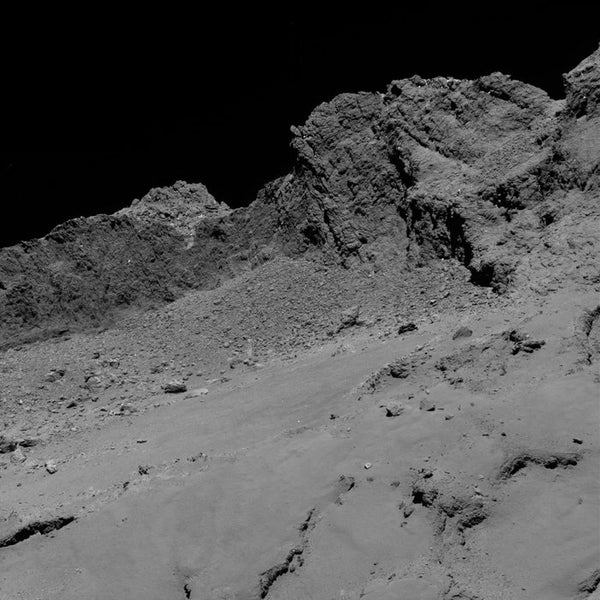
DARMSTADT, Germany—For the last two years, the Rosetta spacecraft has danced around a comet. Today, it finally made contact with the icy body—and sent its last signal.
The European Space Agency's (ESA) Rosetta probe ended its historic mission with a controlled descent to the surface of Comet 67P/Churyumov-Gerasimenko early this morning (Sept. 30). Scientists here at the European Space Operations Centre (ESOC) received the confirmation of landing from the spacecraft at about 1:19 p.m. local time (7:19 a.m. EDT/1119 GMT).
"I can announce the full success of this historic descent," said Patrick Martin, Rosetta mission manager, as he declared mission operations ended. "Farewell Rosetta, you've done the job. That was pure science at its best." [Photos: Europe's Rosetta Comet Mission in Pictures]
On supporting science journalism
If you're enjoying this article, consider supporting our award-winning journalism by subscribing. By purchasing a subscription you are helping to ensure the future of impactful stories about the discoveries and ideas shaping our world today.
Comets are primitive cosmic objects, left over from the time our solar system was just starting to take shape 4.6 billion years ago. Exploring the structure, composition and activity of these icy bodies could shed light on the evolution of our solar system, and help scientists write a more comprehensive history of how the building blocks of life were first delivered to Earth.
Previous robotic expeditions have made close encounters with comets. NASA's Stardust mission even captured dust from the cloud around Comet Wild 2 and returned the sample to Earth in 2006. But Rosetta was the first to orbit a comet, the first to follow one around the sun and the first to send a probe to thesurface of a comet's nucleus.
Today's landing marks the end of an ambitious 1.3-billion-euro ($1.46 billion) mission that spanned more than a decade. The Rosetta spacecraft launched in March 2004, and after a 10-year cruise through the inner solar system covering a distance of 4 billion miles (6.5 billion km), it rendezvoused with Comet 67P in August 2014. Three months later, Rosetta deployed its surface probe Philae. But instead of anchoring to the comet's surface as planned, Philae bounced twice before coming to a stop against a cliff face in the Abydos region. Rosetta only spotted the final resting place of Philae earlier this month.
First observed in 1969, the 2.5-mile-wide (4 km) Comet 67P circles the sun every 6.5 years between the orbits of Earth and Jupiter. Right now the comet is heading back out toward the orbit of Jupiter, and Rosetta, which is solar-powered, wouldn't have enough energy to keep up, so the mission had to come to an end. The spacecraft will stop sending data as soon as it touches down, meaning mission scientists won't know if it tumbles or bounces like Philae did after it lands. [Rosetta Probe's 'Death Dive' Into Comet 67P Visualized]
ESA has already released the final images that Rosetta collected on its way down to the comet's surface.
"It's really great," said Holger Sierks, the principal investigator for Rosetta's OSIRIS camera, as he presented some of the probe's final views. "It’' exciting. It’s working like a charm."
Comet 67P is very porous with low gravity, so Rosetta's landing likely looked more like a slow-motion collision than a violent crash. The spacecraft executed its final maneuver around midnight local time (6:00 p.m. EDT; 2200 GMT) yesterday (Sept. 29) and began a 14-hour, 12-mile (20 km) drop to the comet's surface. ESA officials had calculated that its speed upon impact would be about walking pace, or 2 mph (3.2 km/h).
The controlled impact was designed to give ESA scientists a closer look at surface features they had only spied from afar.
"We got pretty close to the comet recently with the orbits we were doing," Matt Taylor, Rosetta project scientist with ESA, told Space.com. "We got within about 2 kilometers [1.2 miles] from the surface. But this plummet into the surface gets us in below 2 kilometers. It gets us within the acceleration region, where the comet coma grows and starts being thrown off."
The death dive was also an opportunity for Rosetta's suite of instruments to take measurements as it passes through the layer where the phase transition occurs between ice and gas.
Rosetta's final resting place is a smooth patch in the so-called Ma'at region on the "head" of the rubber duck-shaped comet.
This particular spot has a number of dust-spewing pits—some 330 feet (100 m) across and 165 feet (50 m) deep—that scientists wanted Rosetta's instruments to observe before the mission ended. The walls of these pits appear dotted with "goosebumps" that could be signatures of early comet building blocks known as cometesimals.
The mission has already produced a number of surprising discoveries—that the Comet 67P has big grains of water ice on its surface, molecular oxygen in its coma, diverse landscapes and a fluffy core, just to name a few. But Rosetta scientists still have reams of data to pore over. So, even with today's finale, the work isn't over.
"We have 80,000 images to look at," Mohamed El-Maarry, a postdoctoral researcher with Rosetta's OSIRIS team, from the University of Bern in Switzerland, told reporters yesterday. "It's going to keep us busy for years to come."
Rosetta, Europe's Comet-Chasing Spacecraft: Latest News, Images and Video
Philae Comet Landing: Big Discoveries About Comet 67P (Infographic)
Thank You Rosetta! Probe Set To Execute Collision Maneuver | Video
Rosetta, Europe's Comet-Chasing Spacecraft: Latest News, Images and Video
Copyright 2016 SPACE.com, a Purch company. All rights reserved. This material may not be published, broadcast, rewritten or redistributed.