
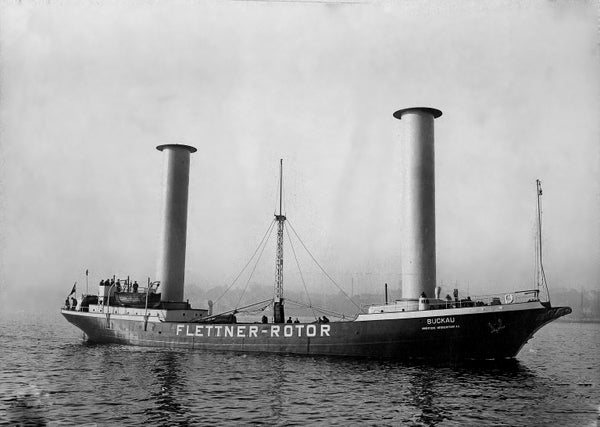
In 1926 a cargo ship called the Buckau crossed the Atlantic sporting what looked like two tall smokestacks. But these towering cylinders were actually drawing power from the wind. Called Flettner rotors, they were a surprising new invention by German engineer Anton Flettner (covered at the time in Scientific American). When the wind was perpendicular to the ship's course, a motor spun the cylinders so their forward-facing sides turned in the same direction as the wind; this movement made air move faster across the front surface and slower behind, creating a pressure difference and pulling the ship forward. The rotating sails provided a net energy gain—but before they could be widely adopted the Great Depression struck, followed by World War II. Like the electric car, the Flettner rotor would be abandoned for almost a century in favor of burning fossil fuel.
Now, with shippers under renewed pressure to cut both costs and carbon emissions, the concept is getting another shot. In one notable example, the 12,000-gross-ton cargo vessel SC Connector is adding 35-meter Flettner rotors that can tilt to near horizontal when the ship passes under bridges or power lines. The new rotors need electrical power to spin, but manufacturer Norsepower says they can still save up to 20 percent on fuel consumption and cut emissions by 25 percent.
The SC Connector is one of a growing series of rotor-boosted ships expected to be operating in various parts of the world by year's end, according to SSPA, a Sweden-based nonprofit research institute. Shipbuilders are also incorporating other wind-propulsion technologies, such as kite-style sails. But Flettner rotors are getting the earliest adoption, says Sofia Werner, a naval architect who leads an SSPA team studying their performance. Ships can easily be retrofitted, literally overnight, with rotors activated by an on/off switch. “It's a quite simple solution, understandable and safe,” Werner says. “It's also very visible, which is good for marketing.”
On supporting science journalism
If you're enjoying this article, consider supporting our award-winning journalism by subscribing. By purchasing a subscription you are helping to ensure the future of impactful stories about the discoveries and ideas shaping our world today.
The United Nations International Maritime Organization has set ambitious decarbonization goals involving marine fuels, and the European Union is now funding rotor research. Climate pressures and easy installation make wind-power systems an attractive option, according to the International Windship Association. “A lot of people wanted to see wind dead [in the 1920s] because they were making a lot of money off fuel,” says Gavin Allwright, the organization's secretary-general. “That's still true today. I can't sell you a unit of wind. What I am bullish about is that where we've got a major decarbonization issue, [alternative fuels] have great potential but are five to 10 years from being proven out. Wind, we could put on a vessel today.”