
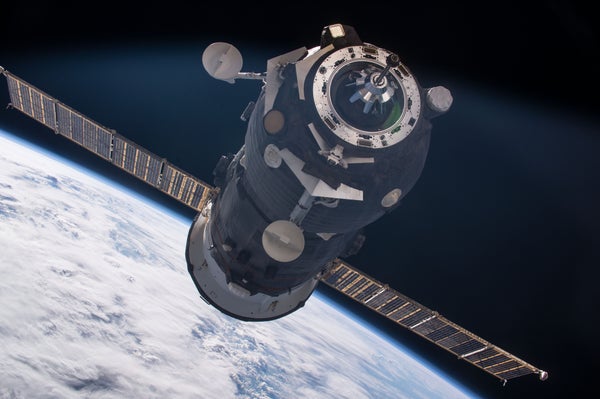

Russia's space agency, Roscosmos, launched a new cargo ship to the International Space Station today (Dec. 1), but the fate of the robotic supply ship is unclear after issues cropped up during its trip into space.
The unmanned Progress 65 spacecraft blasted off atop a Russian Soyuz-U rocket at 9:51 a.m. EST (1451 GMT) from the Baikonur Cosmodrome in Kazakhstan on a mission to deliver more than 2.5 tons (2.3 metric tons) of food, equipment and other supplies to the space station. It was expected to arrive at the space station on Saturday (Dec. 3). [Watch: NASA Explains Status of Progress 65 Spacecraft]
But while the initial moments of the flight went as planned, flight controllers at Russia's mission control center near Moscow detected "ratty telemetry" as the Soyuz booster's third stage was firing.
On supporting science journalism
If you're enjoying this article, consider supporting our award-winning journalism by subscribing. By purchasing a subscription you are helping to ensure the future of impactful stories about the discoveries and ideas shaping our world today.
Today's launch started off seemingly smooth and flawless. During a live webcast of the launch, NASA spokesman Rob Navias of the Johnson Space Center in Houston announced that "all vehicle parameters [were] reported performing perfectly" about 2 minutes after liftoff. Nearly 7 minutes later, the spacecraft achieved preliminary orbit insertion.
But as Progress 65 was entering Earth's orbit, mission controllers began to experience what Navias called ratty telemetry data during the end of the third-stage engine performance. At first it was unclear whether the third-stage engines had shut down and separated from the spacecraft. "Third-stage separation may have happened earlier than planned," Navias said.
Shortly thereafter, Navias announced that telemetry data "received in bits and pieces indicated that the navigational antennas have deployed." However, the fate of the spacecraft's solar arrays was up in limbo. Though telemetry data showed the solar panels were no longer stowed, whether they were successfully deployed remains uncertain.
If the mission is able to carry on, the Progress spacecraft's journey to the orbiting laboratory should last about two days. On Saturday, Progress is scheduled to dock to the station at the Zvezda module at 11:43 a.m. EST (1643 GMT).
Russia's three-module Progress spacecraft have an appearance similar to that of the country's Soyuz crew capsules. But instead of a crew module, the Progress has a module filled with propellant for the International Space Station.
Progress spacecraft are autonomous and can fly themselves to the space station, as well as park at one of several docking ports on the outpost's Russian modules. Cosmonauts inside the station can also take remote control of Progress vehicles if needed. At the end of their mission, Progress vehicles are loaded with trash and unneeded items, undocked from the station and intentionally burned up in Earth's atmosphere.
Progress vehicles are part of a fleet of unmanned cargo ship that keep space station crews stocked with supplies. That fleet includes Japan's H-2 Transfer Vehicle, as well as the Dragon spacecraft built by SpaceX and Cygnus supply ships built by Orbital ATK. The European Space Agency also flew five supply missions with its huge Autonomous Transfer Vehicles before ending that program.
Editor's Note: This story will be updated as new details are available.
EDITOR'S RECOMMENDATIONS
Copyright 2016 SPACE.com, a Purch company. All rights reserved. This material may not be published, broadcast, rewritten or redistributed.