
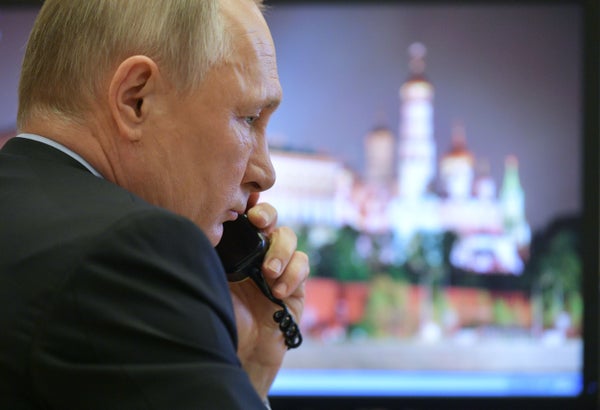
Russia’s president Vladimir Putin announced on August 11 that the country’s health regulator had become the world’s first to approve a coronavirus vaccine for widespread use — but scientists worldwide have condemned the decision as dangerously rushed. Russia hasn’t completed large trials to test its safety and efficacy, and rolling out an inadequately vetted vaccine could put at risk people who receive it, researchers say. It could also impede global efforts to develop quality COVID-19 immunizations, they suggest.
“That the Russians may be skipping such measures and steps is what worries our community of vaccine scientists. If they get it wrong it could undermine the entire global enterprise,” says Peter Hotez, a vaccine scientist at Baylor College of Medicine in Houston, Texas.
“This is a reckless and foolish decision. Mass vaccination with an improperly tested vaccine is unethical. Any problem with the Russian vaccination campaign would be disastrous both through its negative effects on health, but also because it would further set back the acceptance of vaccines in the population,” Francois Balloux, a geneticist at University College London, said in a statement distributed by the UK Science Media Centre.
On supporting science journalism
If you're enjoying this article, consider supporting our award-winning journalism by subscribing. By purchasing a subscription you are helping to ensure the future of impactful stories about the discoveries and ideas shaping our world today.
In his announcement, Putin said that the Russian regulator had approved a COVID-19 vaccine developed by the Gamaleya Research Institute of Epidemiology and Microbiology in Moscow, even though phase III trials of the vaccine had yet to be completed. Such trials involve giving thousands of people a vaccine or a placebo injection, and then following them to see if the vaccine prevents disease. They also allow researchers to confirm the vaccine’s safety and look for rarer side effects that may not have been observed in smaller, earlier stage trials. Russian health-care minister Mikhail Murashko said that the vaccine would be gradually introduced to citizens, and given to health workers and teachers first.
More than 200 COVID-19 vaccines are in development worldwide and several are already in phase III trials, with more frontrunners slated to begin theirs soon. But researchers think that the earliest one of those vaccines could be approved is still months away.
Lack of data
The Gamaleya vaccine has been given to 76 volunteers as part of two early-stage trials listed on ClinicalTrials.gov, but no results from those trials or other preclinical studies have been published, and little else is known about the experimental vaccine.
According to the ClinicalTrials.gov listings, the vaccine, which is given in two doses, is made of two adenoviruses that express the coronavirus spike protein. The first dose is an Ad26 virus — the same strain being used in an experimental vaccine being developed by pharmaceutical company Johnson & Johnson and its subsidiary Janssen — while the second ‘booster’ dose is made of an Ad5 virus, like the one in an experimental jab being developed CanSino Biologics in China.
According to the vaccine’s Russian-language registration certificate, all 38 participants who received one or two doses of the vaccine had produced antibodies against SARS-CoV-2’s spike protein, including potent neutralizing antibodies that inactivate viral particles. These findings are similar to results of early-stage trials of other candidate vaccines. Side effects were also similar, such as fever, headache and skin irritation at the site of injection.
Hotez expects that the Gamaleya vaccine will elicit a decent immune response against SARS-CoV-2. “The technical feat of developing a COVID19 vaccine is not very complicated,” he says. “The hard part is producing these vaccines under quality umbrellas — quality control and quality assurance — and then assuring the vaccines are safe and actually work to protect against COVID19 in large phase III clinical trials.”
But little is known about phase III trial plans for the Gamaleya vaccine. “I simply haven’t managed to find any published details of a protocol,” says Danny Altmann, an immunologist at Imperial College London. He hopes the trial is closely tracking the immune responses of participants and looking out for any side effects.
The head of a Russian government-supported investment fund said the vaccine would go through phase III testing in the United Arab Emirates, Saudi Arabia and other countries, according to the state-owned TASS Russian News Agency. The official said that purchase requests for 1 billion doses had been received by 20 countries, in Latin America, the Middle East, Asia and elsewhere, and that manufacturing was in place to produce 500 million doses, with more capacity in the works.
‘Ridiculous authorization’
Altmann says he is concerned that the vaccine could cause an exacerbated disease that occurs when antibodies generated by the vaccine carry the virus into cells, after exposure to the virus. Another problem could be an asthma-like immune reaction that became an issue with some experimental vaccines against the SARS (sever acute respiratory syndrome) virus. Picking up these reactions would require comparing thousands of people who received a vaccine or placebo and potentially became exposed to SARS-CoV-2.
“It’s ridiculous, of course, to get authorization on these data,” says Svetlana Zavidova, head of Russia’s Association of Clinical Trials Organizations, which works with international pharmaceutical companies and research organizations. Without a completed phase III trial, Zavidova also worries that it will not be clear whether the vaccine prevents COVID-19 or not — or causes any harmful side effects, because of gaps in how Russia monitor the effects of medicines. “Our system for safety monitoring, I think, is not the best,” she says.
Zavidova also worries the vaccine’s approval will be “very harmful” for efforts to run clinical trials of other COVID-19 vaccines and other medicines in Russia.
“Not sure what Russia is up to, but I certainly would not take a vaccine that hasn’t been tested in Phase III,” said Florian Krammer, an immunologist at Icahn School of Medicine at Mount Sinai in New York City, in a tweet. “Nobody knows if it’s safe or if it works. They are putting [health-care workers] and their population at risk.”
This article is reproduced with permission and was first published on August 11, 2020.
Read more about the coronavirus outbreak from Scientific American here. And read coverage from our international network of magazines here.