
This year hasbeen one of incredible loss. We are approaching 200,000 deaths from the COVID-19 pandemic in the U.S. and nearly a million around the globe. And on the streets, the killings of Black, Indigenous, Latinx individuals and other people of color—George Floyd, Breonna Taylor, Daniel Prude, Rayshard Brooks and many othersat the hands of those sworn to protect us continues a long history of loss because of racism.
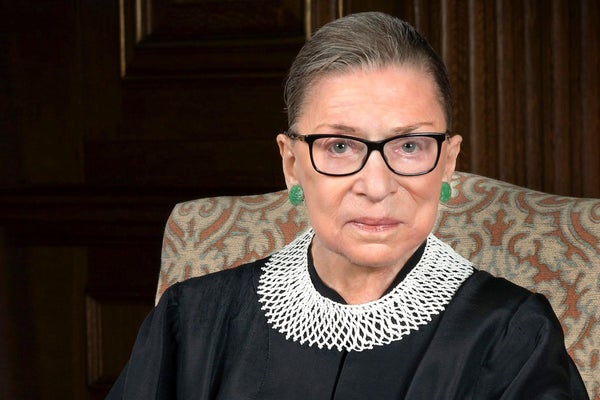
Last night the devastating loss continued with the death of Supreme Court Justice Ruth Bader Ginsburg. Justice Ginsburg was a longtime champion of civil rights and a key vote in a closely divided court. Along with the passing of Representatives Elijah Cummings of Maryland and John Lewis of Georgia, this latest loss feels like a body blow. To those who believe, as I do, that the Fourteenth Amendment of the Constitution’s mandate of equal protection is at the heart of our democracy, the loss of these giants from public life brings even greater unease in a time of extraordinary uncertainty.
Justice Ginsburg would likely have played a pivotal role in in a host of cases before the court in the coming term. A large proportion of those cases involve equal protection or civil rights by my reading. Others involve government transparency, including a case concerning public information related to an Endangered Species Act biological opinion in which the Sierra Club is challenging the U.S. Fish and Wildlife Service and National Marine Fisheries Service. I and my colleagues at the Union of Concerned Scientists have filed an amicus brief supporting greater transparency in that case.
On supporting science journalism
If you're enjoying this article, consider supporting our award-winning journalism by subscribing. By purchasing a subscription you are helping to ensure the future of impactful stories about the discoveries and ideas shaping our world today.
Justice Ginsburg would have also played a critical role in deciding which cases the court would hear in future. Given the long list of attacks on science we have tracked over the past three and a half years and an equally long list of regulatory rollbacks that have been vociferously disputed, it is highly likely some of those issues will ultimately reach the court. Here are a few examples where Justice Ginsburg’s loss will be felt acutely:
There are several coming battles over regulations directly aimed at slowing global warming. These conflicts include legal battles over fuel economy standards for cars and trucks, restrictions on greenhouse gas emissions, grid modernization, holding companies accountable and likely many more issues.
Regulatory rollbacks affecting clean air and water, toxic chemicals, endangered species, consumer product safety, and other public health and safety protections are all under court challenge as we speak. How these battles play out may ultimately involve the nation’s highest court.
The dramatic weakening of the U.S.’s overarching environmental law, the National Environmental Policy Act, raises issues of permitting oil and gas activities, including pipelines, major development projects, Department of Defense activities and virtually all other federal actions. The legal battle will be intense.
The weakening of regulatory protections for political reasons rather than based on scientific evidence has resulted in many disputes in recent years. They include attempts to alter how science is considered in making policy through rules, such as the so-called Strengthening Transparency in Regulatory Science rule proposed at the Environmental Protection Agency, as well asthe way the costs and benefits of regulations may be calculated. Ultimately, court action will result as communities around the country lose key public health and safety protections.
Members of the scientific community—including academic, governmental and civil-society organizations such as the Union of Concerned Scientists—are struggling to overcome a history of systemic racism. Change will not come easily or without challenge as science, technology, engineering and mathematics (STEM) education and STEM career paths necessarily become more diversified and our institutions become more equitable. These issues, too, will result in court battles.
Justice Ginsburg touched the lives of everyone in this country, whether we know it or not. Her passing will be a loss—for women’s rights, civil rights, equal protection and wisdom in our democracy.
I close with a quote from the justice: “Think back to 1787. Who were ‘we the people’? ... They certainly weren't women ... they surely weren’t people held in human bondage. The genius of our Constitution is that over now more than 200 sometimes turbulent years that ‘we’ has expanded and expanded.”