
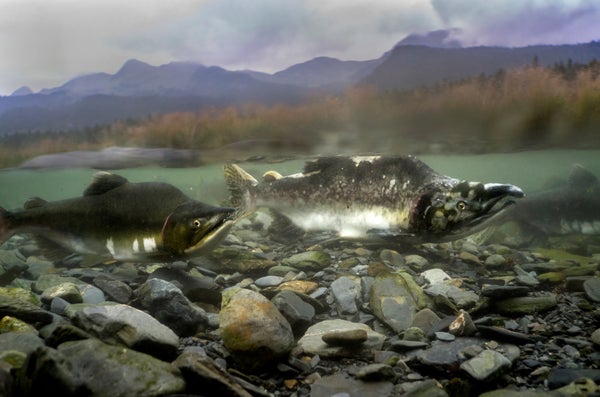
Fish sex might not seem very consequential, but countless couplings over the course of millennia can leave a mark on the landscape. In a recent study, researchers modeled how spawning affects rivers in the Pacific Northwest and concluded that salmon sex actually helped to carve the region's mountainsides.
Salmon return from the sea to the rivers and streams of their birth to reproduce. Once a female finds a spot with the right size rocks or gravel, she digs a pit for her eggs. After the male fertilizes them, the female digs another hole upstream and covers her brood with the sediment from it. Her excavation erodes the streambed by making it easier for sediment and gravel to move downstream, says study co-author Alexander K. Fremier, an aquatic ecologist at Washington State University.
Fremier and his colleagues collected data on salmon-caused erosion rates in an experimental stream and extrapolated their findings to real rivers over millions of years. Spawning may have caused some riverbeds to lower by 30 percent more than if no spawning had taken place, they reported in the study, which was published online last September in the journal Geomorphology.
On supporting science journalism
If you're enjoying this article, consider supporting our award-winning journalism by subscribing. By purchasing a subscription you are helping to ensure the future of impactful stories about the discoveries and ideas shaping our world today.
David R. Montgomery, a professor of geomorphology at the University of Washington, who was not involved in the research, calls the study a fascinating “illustration of the degree to which biological activity and things we normally think of as physical processes can be linked.” Montgomery's own research indicates that mountain uplift may have fueled salmon diversification, specialization and speciation. The new work suggests that salmon spawning could further enhance these processes by changing erosion rates and river slopes. Montgomery believes any such effect would be minimal in comparison to that caused by uplift but adds that Fremier and his colleagues have “opened the door to asking the question” about the phenomenon and all its cascading consequences.