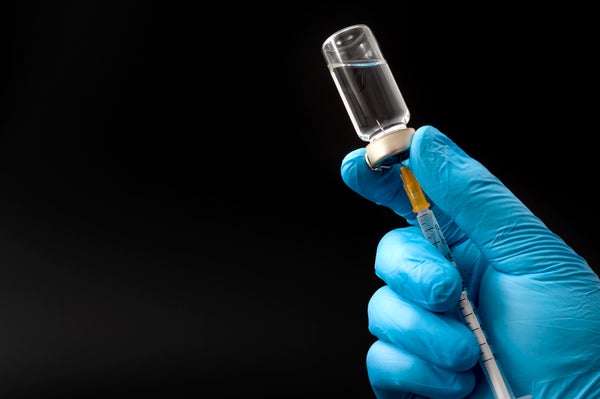
Sanofi Announces It Will Work with HHS to Develop Coronavirus Vaccine

The vaccine likely won’t be ready to test in people for at least a year

Join Our Community of Science Lovers!

The drug maker Sanofi Pasteur is entering the race to develop a vaccine to protect against the new coronavirus sweeping through China, the company announced Monday.

David Loew, Sanofi’s global head of vaccines, announced the company would partner with the U.S. Biomedical Advanced Research and Development Authority—known as BARDA—to make a vaccine using the company’s recombinant DNA platform.

Loew said the company’s previous work to develop a vaccine for SARS—a cousin virus—gives it a leg up on this work.


On supporting science journalism

If you're enjoying this article, consider supporting our award-winning journalism by subscribing. By purchasing a subscription you are helping to ensure the future of impactful stories about the discoveries and ideas shaping our world today.


“Addressing a global health threat such as this newest coronavirus is going to take a collaborative effort, which is why we are working with BARDA to quickly advance a potential vaccine candidate,” said Loew.

“While we are lending our expertise where possible, we believe the collaboration with BARDA may provide the most meaningful results in protecting the public from this latest outbreak,” he said.

Loew said the company expects to have a vaccine candidate—a prototype—to test in vitro within six months and could be ready to test the vaccine in people within a year or 18 months.

Loew noted the DNA recombinant platform is already used to make flu vaccine licensed in the U.S., which means regulators are familiar with it. Sanofi also has large-scale manufacturing capacity for these types of vaccines.

Sanofi is the second major vaccine maker to announce it will try to make a vaccine against the new virus, which has infected over 70,000 people, mostly in China. Johnson & Johnson’s vaccine division, Janssen, has also announced it will try to make a vaccine.

Republished with permission from STAT. This article originally appeared on February 18 2020

Helen Branswell is STAT's infectious diseases and public health reporter. She comes from the Canadian Press, where she was the medical reporter for the past 15 years. Helen cut her infectious diseases teeth during Toronto's SARS outbreak in 2003 and spent the summer of 2004 embedded at the US Centers for Disease Control and Prevention. In 2010-11 she was a Nieman Global Health Fellow at Harvard, where she focused on polio eradication. Warning: Helen asks lots of questions.

More by Helen Branswell

STAT delivers fast, deep, and tough-minded journalism. We take you inside science labs and hospitals, biotech boardrooms, and political backrooms. We dissect crucial discoveries. We examine controversies and puncture hype. We hold individuals and institutions accountable. We introduce you to the power brokers and personalities who are driving a revolution in human health. These are the stories that matter to us all.

More by STAT

It’s Time to Stand Up for Science

If you enjoyed this article, I’d like to ask for your support. Scientific American has served as an advocate for science and industry for 180 years, and right now may be the most critical moment in that two-century history.

I’ve been a Scientific American subscriber since I was 12 years old, and it helped shape the way I look at the world. SciAm always educates and delights me, and inspires a sense of awe for our vast, beautiful universe. I hope it does that for you, too.

If you subscribe to Scientific American, you help ensure that our coverage is centered on meaningful research and discovery; that we have the resources to report on the decisions that threaten labs across the U.S.; and that we support both budding and working scientists at a time when the value of science itself too often goes unrecognized.

In return, you get essential news, captivating podcasts, brilliant infographics, can't-miss newsletters, must-watch videos, challenging games, and the science world's best writing and reporting. You can even gift someone a subscription.

There has never been a more important time for us to stand up and show why science matters. I hope you’ll support us in that mission.

Thank you,

David M. Ewalt, Editor in Chief, Scientific American

Subscribe